PAYDEX Score: The Complete Guide to Your D&B Business Credit Score
Your PAYDEX is Dun & Bradstreet's business credit score, from 1 to 100, built almost entirely from whether you pay early or late. Here is how it works and how to build an 80-plus.
Company Base OS Research
Updated July 18, 2026 · 52 min read
In this article
- What is a PAYDEX score?
- The PAYDEX scale, from 1 to 100
- How the PAYDEX is calculated
- Why 80 is the number everyone talks about
- How to get a PAYDEX score in the first place
- How to build an 80+ PAYDEX, step by step
- How to push your PAYDEX above 80
- What lenders and suppliers actually do with your PAYDEX
- The other Dun & Bradstreet scores, briefly
- PAYDEX vs. Experian and Equifax business scores
- Why your PAYDEX is low, or missing entirely
- How to raise a low PAYDEX
- How to check and monitor your PAYDEX
- Myths about the PAYDEX score
- How long it takes to build a strong PAYDEX
- A worked example
- Your PAYDEX action plan
- The days-beyond-terms scale, in practice
- How your PAYDEX affects the credit you actually get
- Where the PAYDEX fits in the whole build
- Which vendors report to Dun & Bradstreet
- How to read your Dun & Bradstreet report
- PAYDEX for a new business vs. an established one
- Protecting your PAYDEX for the long run
- Glossary: PAYDEX terms
- PAYDEX vs. your personal credit score
- How suppliers turn your PAYDEX into a credit limit
- Troubleshooting common PAYDEX situations
- Building the early-payment habit
- A note on the D-U-N-S number and government work
- Case study: raising a stalled PAYDEX
- The PAYDEX numbers worth memorizing
Key takeaways
- 1.Your PAYDEX is Dun & Bradstreet's business credit score, a number from 1 to 100 built almost entirely from whether you pay your bills on time or early.
- 2.A PAYDEX of 80 means you pay exactly on terms. Every point above 80 is earned by paying before the due date, which is the single most powerful habit in business credit.
- 3.You need a D-U-N-S number and at least a couple of reporting trade experiences before a PAYDEX can be calculated at all.
- 4.PAYDEX is dollar-weighted: larger accounts move your score more than tiny ones, so how you handle your bigger tradelines matters most.
- 5.You cannot buy a good PAYDEX. You build it by getting reporting accounts, paying early, and giving it a little time.
If business credit has a headline number, it is the PAYDEX. When a supplier decides how much to extend to you, or a lender sizes up your business, the PAYDEX score from Dun & Bradstreet is often the first thing they look at. It is simple, it is powerful, and it is almost entirely within your control, because it is built from one thing above all others: how promptly you pay. This guide explains exactly what a PAYDEX score is, how it is calculated, how to build one from scratch, and how to push it into the range that gets you the best terms.
The best news about the PAYDEX is that there is no mystery to game and no fee to pay. Unlike a personal FICO score, which blends five different factors, the PAYDEX cares mostly about a single behavior you fully control. Understand how it works and you can build a strong one deliberately, on purpose, in a matter of months. Let us take it apart.
What is a PAYDEX score?
The PAYDEX score is Dun & Bradstreet's measure of your business's payment performance, expressed as a number from 1 to 100. A higher number means you pay more promptly. It is calculated from the payment experiences that your vendors, suppliers, and creditors report to Dun & Bradstreet about your business, and it is tied to your business through your D-U-N-S number, the free identifier D&B assigns to your company.
Think of the PAYDEX as your business's payment reputation, distilled into a single figure. Where a personal credit score weighs how much you owe, how long you have had credit, and how many new accounts you have opened, the PAYDEX is far more focused. It answers one question with unusual clarity: when this business gets a bill, does it pay on time, early, or late? That focus is what makes it both easy to understand and easy to influence.
Why the PAYDEX matters most
The PAYDEX is one of several scores Dun & Bradstreet keeps on your business, but it is the one lenders and suppliers reference most often when deciding your terms. It is worth building deliberately.
The PAYDEX scale, from 1 to 100
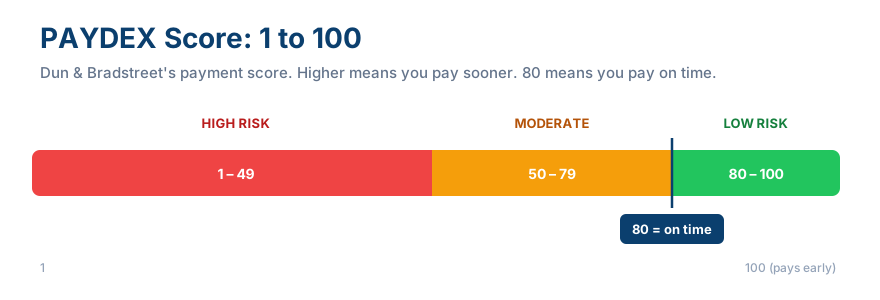
The PAYDEX runs from 1 to 100, and the whole scale maps to how many days, relative to your agreed terms, you tend to pay. Dun & Bradstreet groups the range into risk bands. Here is how the scale breaks down.
| PAYDEX | Payment behavior | Risk band |
|---|---|---|
| 100 | Pays about 30 days before terms | Low risk |
| 90 | Pays about 20 days before terms | Low risk |
| 80 | Pays exactly on terms | Low risk |
| 70 | Pays about 15 days beyond terms | Medium risk |
| 50 | Pays about 30 days beyond terms | Medium risk |
| 40 | Pays about 60 days beyond terms | High risk |
| 20 | Pays about 120 days beyond terms | High risk |
| 1 | Pays well over 120 days beyond terms | High risk |
Approximate mapping. The key line is 80: it is the boundary of the low-risk, fundable zone, and it means paying exactly on time.
Two numbers on this scale matter more than the rest. The first is 80, because it is the threshold most suppliers and lenders treat as the mark of a reliable payer, and it corresponds to paying exactly on your agreed terms. The second is anything above 80, because those scores can only be reached by paying early, before the due date. That single fact, that early payment is the only path above 80, is the most important thing to understand about the PAYDEX.
How the PAYDEX is calculated
The PAYDEX is built from the payment experiences your creditors report to Dun & Bradstreet. Each time a vendor reports how you paid, whether early, on time, or a certain number of days late, that experience feeds your score. Two features of the calculation are worth understanding, because they shape how you should build.
It is based on days beyond terms
The core input is how many days, relative to your agreed terms, you actually pay. Pay a net-30 bill on day 30 and you are on terms, worth an 80. Pay it on day 20 and you are ten days early, pushing you above 80. Pay it on day 45 and you are fifteen days beyond terms, dragging you below 80. The score is essentially a weighted average of these payment experiences translated onto the 1-to-100 scale.
It is dollar-weighted
Not all tradelines count equally. The PAYDEX is dollar-weighted, meaning larger accounts influence your score more than small ones. A late payment on a large account hurts more than a late payment on a tiny one, and prompt payment on your bigger tradelines helps more. The practical implication: be especially disciplined on your larger accounts, because they carry the most weight.
What this means for you
Because the score is dollar-weighted and based on reported experiences, the way to control it is straightforward: make sure your accounts report, keep your larger accounts in perfect standing, and pay everything early. There is no hidden factor.
Why 80 is the number everyone talks about
Across the business credit world, you will hear that you want a PAYDEX of 80 or above. Here is why. An 80 means your business pays exactly on terms, and to most suppliers and lenders, on-time payment is the definition of a low-risk customer. It is the score at which trade credit opens up, terms improve, and many automated systems flag your business as a reliable payer. Falling below 80 signals that you tend to pay late, which tightens terms and closes doors.
But here is the subtlety that separates owners who understand the PAYDEX from those who do not: 80 is the ceiling for paying on time. If you always pay exactly on the due date, you will settle around 80 and no higher. To climb into the 90s and toward 100, you must pay early, consistently, on your reporting accounts. That is why the guidance throughout every business credit guide is to pay early, not merely on time. On-time payment keeps you fundable; early payment makes you exceptional.
How to get a PAYDEX score in the first place
A brand-new business does not have a PAYDEX. The score does not exist until there is enough reported payment data to calculate it. Getting your first PAYDEX comes down to three steps.
- Get a D-U-N-S number. This free identifier from Dun & Bradstreet is what opens your D&B file. Without it, there is nothing for a PAYDEX to attach to. See how to sign up with Dun & Bradstreet.
- Open reporting trade accounts. Your PAYDEX is built from vendors that report to Dun & Bradstreet. Open net-30 vendor accounts known to report, and place a small order on each so there is activity to report. Our net-30 vendor guide covers how to choose them.
- Pay, and let the data arrive. Once your vendors report your payments, Dun & Bradstreet has enough to calculate a score. This typically requires at least a couple of reported trade experiences, and it usually appears within 30 to 60 days of your first reported payments.
Notice that the first PAYDEX and the beginning of your whole business credit file are the same event. The reporting net-30 accounts that create your D&B file are the same accounts that generate your first PAYDEX. Build one and you are building the other.
How many accounts you need
You generally need at least two or three reporting trade experiences before a PAYDEX is calculated. This is one more reason the standard advice is to open three reporting net-30 accounts as your Tier 1: it is exactly enough to establish a score.
See your fundability, PAYDEX and all
Company Base OS tracks your business credit across the bureaus and turns it into one clear score and next step. Take the free Fundability quiz and find out exactly where you stand and what to fix first.
Get my free Fundability ScoreHow to build an 80+ PAYDEX, step by step
An 80-plus PAYDEX is the goal for most businesses, because it is the low-risk, fundable zone. Here is the exact sequence to build one from nothing.
- Get your D-U-N-S number so your D&B file exists.
- Open three net-30 vendor accounts that report to Dun & Bradstreet.
- Place a small, real order on each account so there is a payment to report.
- Pay each invoice on time at the very least, and ideally early. On-time payment establishes an 80; early payment builds above it.
- Confirm the accounts are reporting by checking your D&B file after 30 to 60 days.
- Repeat with additional reporting accounts to add depth, keeping every one paid early.
That is the entire method. There is no step where you pay a fee to boost the number, and no shortcut that skips the reporting-and-paying cycle. The PAYDEX rewards exactly one thing, prompt payment on reporting accounts, and this sequence delivers it.
How to push your PAYDEX above 80
Once you are reliably at 80, the only way up is to pay early, and to do it consistently across your reporting accounts. Because the score reflects your average days beyond terms, paying a handful of days early on most of your accounts nudges you into the 80s, and paying consistently early, roughly twenty to thirty days ahead of terms, is what reaches for the 90s and 100.
A few practical habits make early payment automatic. Pay invoices the day they arrive rather than waiting for the due date. Set reminders a week or two before anything is due. And prioritize early payment on your larger accounts, since the score is dollar-weighted and your bigger tradelines move it most. None of this costs anything beyond a little discipline, and the payoff is a score that signals not just reliability but excellence.
Focus where it counts
You do not need every account to be paid weeks early to have a strong PAYDEX. Consistent early payment on your reporting accounts, especially the larger ones, is what carries the score into the 90s. Perfection on the big accounts beats sporadic effort on all of them.
What lenders and suppliers actually do with your PAYDEX
Understanding who reads your PAYDEX and why makes it easier to see why building it matters. Suppliers use it to decide whether to extend trade credit and how much, so a strong PAYDEX can mean better terms and higher credit limits from the vendors you buy from. Lenders reference it as part of their risk assessment when you apply for financing. Some larger companies check it before entering a contract or partnership, treating it as a signal of stability. And certain insurers and lessors factor it into their decisions.
In every case, the PAYDEX is functioning as a shorthand for trust. A number at or above 80 tells the other party, quickly and without a lengthy investigation, that your business pays its obligations. That trust translates into concrete advantages: more credit, better terms, smoother approvals, and fewer deposits. It is one of the highest-leverage numbers in your business precisely because so many decisions reference it.
The other Dun & Bradstreet scores, briefly
The PAYDEX gets the attention, but Dun & Bradstreet keeps several scores on your business, and it helps to know what each one measures so you are not confused when you see them. You generally view these through D&B's paid products, and the PAYDEX remains the most actionable for most owners.
- PAYDEX Score: your payment performance, 1 to 100. The one you build most directly by paying early.
- D&B Delinquency Predictor Score: estimates the likelihood that your business will pay severely late in the near future. Reported as a percentile and a risk class.
- D&B Failure or Financial Stress Score: estimates the likelihood that your business will cease operations or become financially distressed.
- D&B Rating: a summary of your company's size, often tied to net worth, alongside a credit appraisal, shown as a code like 5A1.
- Supplier Evaluation Risk (SER) Rating: a 1-to-9 scale predicting the likelihood a business will stop operating, used mainly by suppliers.
The common thread: PAYDEX is about how you pay, while the predictor and failure scores are about risk and stability, blending your payment behavior with other data such as company age, size, and public records. You cannot control the predictive models directly, but paying early, keeping your file clean, and building depth improves the inputs to all of them at once.
PAYDEX vs. Experian and Equifax business scores
Dun & Bradstreet is not the only business bureau, and the PAYDEX is not the only business score. Experian Business and Equifax Business each keep their own file and their own scores, and lenders may pull any of the three.
| Dun & Bradstreet | Experian Business | Equifax Business | |
|---|---|---|---|
| Headline score | PAYDEX (1-100) | Business risk scores | Business risk scores |
| Main driver | Payment timing (days beyond terms) | Payment history plus utilization, age, inquiries, public records | Payment history plus credit usage, size, age, public records |
| To have a file | Requires a D-U-N-S number | Builds automatically as data arrives | Builds automatically as data arrives |
| Best lever | Pay early on reporting accounts | Pay early, keep utilization low, stay consistent | Pay early, keep utilization low, build depth |
The habits that build a strong PAYDEX, early payment, low utilization, reporting depth, and clean identity, improve all three bureaus at once.
The reassuring takeaway is that you do not manage three scores with three different strategies. The same handful of habits lifts all of them together. Where the PAYDEX is unusually pure, focused almost entirely on payment timing, the Experian and Equifax scores blend in more factors, which is why depth and low utilization matter a little more for them. Build well for the PAYDEX and you build well for all three. Compare them in detail in our business credit bureaus comparison.
Build every business credit score at once
The habits are the same across all three bureaus. Company Base OS shows you the exact accounts to open and when, so your PAYDEX and your Experian and Equifax files all climb together. Start with the free Fundability quiz.
Get my free Fundability ScoreWhy your PAYDEX is low, or missing entirely
If you check for your PAYDEX and find it low or absent, the cause is almost always one of a handful of things, and each has a fix.
No score at all
If you have no PAYDEX, it usually means one of three things: you do not yet have a D-U-N-S number, you have no accounts reporting to Dun & Bradstreet, or you have too few reported trade experiences for a score to be calculated. The fix is to get your D-U-N-S number and open reporting net-30 accounts, then wait for the data to arrive.
A low score
A low PAYDEX almost always traces back to paying beyond terms. Even a few late payments on reporting accounts pull the average down, and because the score is dollar-weighted, a late payment on a larger account does outsized damage. The fix is to bring everything current, resume paying early, and let the fresh positive history rebuild the average over time.
The fastest way to hurt your PAYDEX
A single late payment can undo months of PAYDEX progress. If protecting the score matters to you, set every reporting account to pay automatically, early, so a missed due date never happens by accident.
How to raise a low PAYDEX
Raising a PAYDEX uses the same levers that built it, applied with a little more urgency.
- Bring every reporting account current immediately. Ongoing lateness does far more damage than an old, isolated slip.
- Resume paying early on everything, prioritizing your larger accounts because they carry the most weight.
- Add new reporting tradelines, paid early from day one, to dilute the older negative experiences with fresh positive data.
- Confirm your accounts are actually reporting, since an account you are paying early does nothing for your score if it never posts.
- Give it time. As your recent early payments accumulate and older late marks age, the weighted average climbs.
What will not work is paying a service to raise your PAYDEX artificially. The score reflects reported payment behavior, and no third party can rewrite accurate payment history. The legitimate levers are free, and they work if you apply them consistently.
How to check and monitor your PAYDEX
You can view your PAYDEX and monitor changes through Dun & Bradstreet's own products. D&B offers a range of monitoring options, and while product names and free tiers change over time, the core idea is constant: you can see your score and get alerted when it moves. You do not need to buy every premium product to stay on top of it; you need to know your number, confirm your accounts are reporting, and watch the trend.
Beyond D&B's own tools, a fundability platform can track your PAYDEX alongside your Experian and Equifax files in one place, which saves you from logging into three systems. However you monitor it, check before any application and periodically as you build, so you catch a reporting error or a missed payment before it costs you an approval.
Myths about the PAYDEX score
- “You can buy a good PAYDEX.” No. It reflects reported payment behavior. Fees do not change it.
- “Paying on time gives you a perfect score.” On-time payment caps you around 80. Only early payment goes higher.
- “One vendor is enough for a PAYDEX.” You generally need at least two or three reporting trade experiences before a score is calculated.
- “The PAYDEX is the only score that matters.” It is the most referenced, but lenders may also pull Experian and Equifax, and D&B's own risk scores.
- “Checking my PAYDEX hurts it.” Checking your own business credit is not a hard inquiry and does not affect your score.
How long it takes to build a strong PAYDEX
From a standing start, a realistic timeline looks like this: your first reporting accounts post within 30 to 60 days, which is when a PAYDEX first appears. With three reporting accounts all paid early, you can reach 80 or above within a few months of your file being established. Climbing into the 90s takes longer, because it requires a sustained pattern of early payment across your accounts, but it is entirely achievable within the first year of disciplined building. The score rewards consistency over time, so the businesses with the strongest PAYDEX scores are simply the ones that paid early, every time, for the longest.
A worked example
Picture a new business that gets its D-U-N-S number and opens three reporting net-30 vendor accounts in its first two months, placing a small order on each. It pays every invoice about a week before the due date. Around day fifty, the vendors report those first payments, and a PAYDEX appears, already comfortably in the low-risk zone because the payments were early rather than merely on time. Over the next several months, the business keeps paying every account early and adds a couple more reporting tradelines. By month six, its PAYDEX has climbed into the high 80s, and suppliers begin extending larger limits and better terms. Nothing here was unusual. It was a D-U-N-S number, reporting accounts, and the discipline to pay early, every time.
Your PAYDEX action plan
- Get your D-U-N-S number so your D&B file exists.
- Open three net-30 vendor accounts that report to Dun & Bradstreet.
- Use each account and pay every invoice early, not just on time.
- Confirm the accounts are reporting after 30 to 60 days.
- Keep paying early, prioritizing your larger accounts, and add depth over time.
- Monitor your score, confirm accounts keep reporting, and never let a payment slip.
The one-sentence version
The whole PAYDEX strategy fits in one sentence: get reporting accounts, pay them early, and give it time. Everything else is detail.
The days-beyond-terms scale, in practice
Because the PAYDEX is built from how many days beyond terms you pay, it helps to see the mechanics with concrete numbers. Suppose you have a net-30 account, meaning payment is due 30 days after the invoice. Here is how different payment days translate.
- Pay on day 1 to 10: you are paying roughly 20 to 30 days early, the behavior behind PAYDEX scores approaching 100.
- Pay on day 15 to 20: you are about 10 to 15 days early, pushing your score into the high 80s and low 90s.
- Pay on day 30: you are exactly on terms, the behavior behind an 80.
- Pay on day 45: you are about 15 days beyond terms, which pulls a score down toward 70.
- Pay on day 60: you are about 30 days beyond terms, dragging toward 50 and the medium-risk band.
Two things stand out from this. First, the difference between an 80 and a 90 is not dramatic behavior; it is simply paying a couple of weeks early instead of on the due date, which almost any business can do with a little planning. Second, lateness is punished more steeply than earliness is rewarded, so the priority order is clear: never pay late, then work on paying early. Because the score is an average of your experiences, one badly late payment can offset several early ones, which is why consistency matters as much as speed.
Automate your way to a strong score
If you set every reporting account to pay automatically about ten days before its due date, you will naturally settle into the high 80s or low 90s without thinking about it. Automation is the simplest PAYDEX strategy there is.
How your PAYDEX affects the credit you actually get
A PAYDEX is not a trophy; it is a lever that changes real outcomes. Suppliers use it to set your trade limits and terms, so a business with a strong PAYDEX is offered larger net-30 and net-60 lines, sometimes automatically, while a business with a weak or missing score is kept on tight terms or asked to prepay. Those larger trade lines improve your cash flow at no cost, which is a tangible benefit of the score long before any loan is involved.
When you move toward cash credit, business cards, lines of credit, and loans, the PAYDEX becomes one of the signals a lender weighs alongside your bank behavior, time in business, and revenue. A strong PAYDEX will not, by itself, guarantee a large loan, but it removes a common reason for a decline and improves your terms. Think of it as clearing a hurdle: an 80-plus PAYDEX means payment history is no longer a mark against you, which lets your other strengths carry the application. Where your business credit ultimately leads, lines of credit, bank funding, and more, is covered in our line of credit requirements guide.
Where the PAYDEX fits in the whole build
It is easy to fixate on the PAYDEX as a number to chase, but it is really a byproduct of building your business credit correctly. When you follow the standard three-tier build, opening reporting net-30 vendors, then store cards, then business cards, and paying everything early, a strong PAYDEX emerges naturally. You do not build a PAYDEX and separately build your file; they are the same work. The reporting accounts that create your D&B file generate your PAYDEX, and the early-payment habit that raises your PAYDEX is the same habit that strengthens your Experian and Equifax scores.
This is why the best way to think about the PAYDEX is not as a target to optimize in isolation but as a gauge that confirms you are building well. If your PAYDEX is climbing, you are paying early on reporting accounts, which is exactly what you should be doing. Follow the complete guide to building business credit, pay early throughout, and the PAYDEX takes care of itself.
Which vendors report to Dun & Bradstreet
Since your PAYDEX is built only from accounts that report to Dun & Bradstreet, choosing the right vendors is the practical heart of building the score. Not every vendor reports, and a vendor that does not report contributes nothing to your PAYDEX no matter how promptly you pay. Starter net-30 vendors, the kind that sell business supplies, packaging, office products, and similar goods, are the common on-ramp precisely because many of them report and many approve thin, new files.
The way to be sure is to verify. A reporting vendor will usually state that it reports to the business bureaus, and you can confirm by checking your D&B file 30 to 60 days after your first paid order to see the tradeline appear. Prioritize vendors that report to more than one bureau, since that gives you PAYDEX progress at D&B and file-building at Experian and Equifax from the same account. Our net-30 vendor accounts guide explains how to choose and verify them.
How to read your Dun & Bradstreet report
When you view your D&B file, a handful of elements tell you almost everything you need to know.
- Your D-U-N-S number and business identity: confirm your legal name, address, and phone are correct and consistent with your other records.
- Your PAYDEX score: your headline payment number, from 1 to 100.
- Trade experiences: the individual accounts reporting your payments, each showing the amount and how you paid relative to terms. Confirm the accounts you opened appear and show early or on-time payments.
- D&B risk indicators: the delinquency and failure scores, which blend your payment behavior with other risk data.
- Public records: any liens or judgments, which carry real weight and should be addressed if inaccurate.
Reviewing this regularly is how you catch a missing tradeline, an identity error, or a mistaken late mark before it costs you. Checking your own file never creates a hard inquiry and never lowers your PAYDEX, so review it freely, and always before an application.
PAYDEX for a new business vs. an established one
The path to a strong PAYDEX differs slightly depending on where your business starts. A brand-new business has no score at all and must first create one by getting a D-U-N-S number and opening reporting accounts; its early challenge is simply establishing the score, then getting it to 80 by paying early. An established business that has been operating for years but never deliberately built its file may already have a PAYDEX, sometimes a weak one, from whatever accounts happened to report. Its challenge is different: identify why the score is where it is, bring any late accounts current, and layer on new reporting tradelines paid early to lift the average.
In both cases the levers are identical, get reporting accounts, pay early, add depth, and give it time, but the starting point shapes the emphasis. New businesses focus on creating the score; established businesses focus on correcting and raising it. Either way, the destination is the same: an 80-plus PAYDEX that marks you as a reliable payer.
Protecting your PAYDEX for the long run
A strong PAYDEX is easier to lose than to build, because a single late payment on a reporting account can undo months of progress in one stroke. Protecting it comes down to a few habits. Automate payments so a due date never passes unnoticed. Keep a cash buffer in your business account so a tight month never forces a late payment. Prioritize your larger accounts, since the score is dollar-weighted and they move it most. And monitor your file so that if an error or an unexpected late mark appears, you catch and address it quickly. Treat the PAYDEX the way you treat your business's reputation, because that is precisely what it is: something that compounds when tended and erodes when neglected.
Glossary: PAYDEX terms
- PAYDEX: Dun & Bradstreet's payment-based business credit score, 1 to 100.
- D-U-N-S number: the free Dun & Bradstreet identifier your PAYDEX attaches to.
- Days beyond terms: how many days after your agreed due date you actually pay; the core PAYDEX input.
- Trade experience: a single reported account and its payment history; a few are needed for a PAYDEX.
- Dollar-weighted: larger accounts influence the PAYDEX more than smaller ones.
- On terms: paying exactly on the due date, which corresponds to a PAYDEX of 80.
PAYDEX vs. your personal credit score
Owners coming from the world of personal credit often assume the PAYDEX works like a FICO score. It does not, and the differences matter for how you build it.
| PAYDEX (business) | FICO (personal) | |
|---|---|---|
| Range | 1 to 100 | 300 to 850 |
| Main driver | Payment timing, days beyond terms | A blend: payment history, amounts owed, length of history, new credit, mix |
| How to reach the top | Pay early, consistently | Optimize several factors at once |
| Weighting | Dollar-weighted by account size | Utilization and history weigh heavily |
| What it ignores | Age of file and credit mix matter little to PAYDEX itself | Nothing; all five factors count |
The PAYDEX is far more focused than a FICO score, which is good news: one behavior, paying early, drives it.
The practical upshot is that a PAYDEX is, in some ways, simpler to build than a great personal score. You are not balancing five competing factors; you are doing one thing well. That focus is why a disciplined business can reach an excellent PAYDEX in its first year, even while its owner's personal credit is still improving. The two scores live in different systems and follow different rules.
How suppliers turn your PAYDEX into a credit limit
It is worth understanding the mechanics of how a strong PAYDEX becomes real buying power, because it demystifies why the score matters day to day. When you apply for terms with a new supplier, or when an existing supplier reviews your account, they often pull your D&B file and look at your PAYDEX alongside your trade history and, sometimes, D&B's risk scores. A PAYDEX at or above 80 tells them, at a glance, that you pay reliably, which makes them comfortable extending a larger net-30 or net-60 line and, in some cases, doing so automatically.
This creates a compounding effect that works in your favor. Early trade lines build your PAYDEX; a stronger PAYDEX earns you larger trade lines; larger trade lines, paid early, build your PAYDEX further and add depth to your file. Each cycle strengthens the next. It is the quiet engine behind a healthy business credit profile, and it runs on one simple input: paying early, every time.
Troubleshooting common PAYDEX situations
A few specific situations come up often enough to address directly.
“I have paid on time for months but have no score.”
Almost always this means your accounts are not reporting to Dun & Bradstreet, or you do not have a D-U-N-S number yet, or you have too few reported experiences. Confirm you have a D-U-N-S number, verify which of your vendors report to D&B, and if necessary add reporting accounts. Prompt payment on non-reporting accounts builds no PAYDEX.
“My PAYDEX dropped suddenly.”
A sudden drop usually reflects a recently reported late payment, and because the score is dollar-weighted, a late payment on a larger account can move it noticeably. Check your file for the offending experience, bring the account current, and resume early payment. The score recovers as fresh positive data accumulates.
“My PAYDEX is stuck at 80.”
A score parked at exactly 80 is the signature of paying on the due date rather than before it. To move higher, start paying your reporting accounts early, ideally a week or two ahead of terms, and the score will climb into the high 80s and 90s over the following reporting cycles.
The three-cause rule
Nearly every PAYDEX problem reduces to one of three things: no reporting accounts, a late payment, or paying on time instead of early. Diagnose which one you have, and the fix follows directly.
Building the early-payment habit
Since early payment is the entire secret of a strong PAYDEX, it is worth building a system so it happens automatically rather than relying on memory. A few approaches work well. Set every reporting account to autopay about ten days before its due date, so early payment is the default and requires no thought. Keep a modest cash buffer in your business account dedicated to covering these bills, so a tight week never forces a late payment. And review your upcoming invoices once a week, paying anything due within the next two weeks immediately rather than waiting.
These are small habits, but they are the difference between a PAYDEX that drifts around 80 and one that sits confidently in the 90s. Because the score rewards consistency, the businesses with the strongest PAYDEX are not the ones that occasionally pay weeks early; they are the ones that reliably pay a little early, every time, for years. Systematize the habit and the score follows.
A note on the D-U-N-S number and government work
You may encounter the D-U-N-S number in contexts beyond credit, particularly government contracting, where it was historically used to identify businesses. Federal systems have shifted to a different identifier for registration purposes, but the D-U-N-S number remains central to your Dun & Bradstreet business credit file and your PAYDEX. For the purposes of building business credit, the point is simple: your free D-U-N-S number is what opens your D&B file and lets a PAYDEX be calculated, and that role has not changed. If you plan to pursue government or large corporate contracts, having a clean, established D&B file with a strong PAYDEX only helps.
Case study: raising a stalled PAYDEX
To see the levers work together, consider a two-year-old landscaping business that had drifted into trouble without realizing it. The owner had opened several supply accounts over the years and generally paid them, but often a week or two late during slow winter months. When a bank pulled the file for a line of credit application, the PAYDEX sat at 62, squarely in the medium-risk band, and the application was declined.
The diagnosis was straightforward. Several reporting accounts showed a pattern of paying fifteen to twenty days beyond terms, and because two of those accounts were the business's largest, the dollar-weighting dragged the whole score down. The fix followed the standard recovery order. First, the owner brought every account current and set up automatic payments timed ten days before each due date, so lateness could not recur. Second, the owner opened two additional reporting net-30 accounts and paid them early from the start, adding fresh positive, on-time experiences to dilute the older late ones. Third, the owner kept a small winter cash reserve specifically to cover supply bills during the slow season.
Over the next four months, the reported experiences shifted. The new accounts posted early payments, the existing accounts began showing on-time and then early payments, and the weighted average climbed. By month five the PAYDEX had reached 81, and by month eight it stood at 88. The business re-applied for its line of credit and, with payment history no longer a mark against it, was approved. Nothing exotic happened here. The owner stopped paying late, started paying early, added reporting depth, and let time do the rest, which is the entire PAYDEX playbook applied under a little pressure.
The PAYDEX numbers worth memorizing
If you remember nothing else, remember these few figures, because they capture the whole score.
80
pays on terms, the fundable threshold
90+
earned only by paying early
30-60
days for a new PAYDEX to first appear
Everything else is commentary. Get to 80 by never paying late, climb above it by paying early, and understand that the score first appears within a couple of months of your accounts reporting. A business owner who internalizes those three facts, and acts on them, will build a PAYDEX that opens doors.
Frequently asked questions
What is a good PAYDEX score?
80 or above is the low-risk, fundable zone and the target for most businesses. It corresponds to paying exactly on terms. Scores in the 90s, reached by paying early, are excellent and unlock the best terms.
How is a PAYDEX score calculated?
From the payment experiences your vendors report to Dun & Bradstreet, based on how many days relative to your terms you pay, and weighted by the dollar size of each account. Early payment raises it; late payment lowers it.
How do I get a PAYDEX score?
Get a free D-U-N-S number, open net-30 vendor accounts that report to Dun & Bradstreet, use them, and pay early. Once a couple of trade experiences are reported, a PAYDEX is calculated, usually within 30 to 60 days.
Why is 80 the magic PAYDEX number?
An 80 means you pay exactly on terms, which most suppliers and lenders treat as the mark of a reliable, low-risk payer. It is the threshold where trade credit and better terms open up.
How do I get a PAYDEX above 80?
Pay early, consistently, on your reporting accounts. On-time payment caps you at about 80; only paying before the due date moves you into the 90s and toward 100.
How many tradelines do I need for a PAYDEX?
Generally at least two or three reporting trade experiences before a score is calculated. Opening three reporting net-30 accounts is the common way to establish one.
Does checking my PAYDEX lower it?
No. Checking your own business credit is not a hard inquiry and does not affect your PAYDEX. Only applications create hard inquiries.
Can I pay someone to raise my PAYDEX?
No legitimate service can rewrite accurate payment history. The score reflects reported behavior. Anyone promising to boost it for a fee is selling a shortcut that does not exist.
Is the PAYDEX the same as my business credit score?
It is Dun & Bradstreet's business credit score and the most referenced one, but Experian and Equifax keep their own business scores too. Lenders may pull any of the three.
How long does it take to build a good PAYDEX?
A score appears within 30 to 60 days of your first reported payments. Reaching 80-plus takes a few months of paying early; the 90s take a year or so of consistent early payment.
Why do I have no PAYDEX if I pay all my bills on time?
Because your accounts probably do not report to Dun & Bradstreet, or you lack a D-U-N-S number, or you have too few reported experiences. Only accounts that report to D&B build a PAYDEX.
Does the PAYDEX affect my personal credit?
No. The PAYDEX is a business score tied to your EIN and D-U-N-S number. It is separate from your personal FICO score, which is tied to your Social Security number.
Is a PAYDEX of 100 realistic?
It is achievable but requires consistently paying about 30 days ahead of terms across your reporting accounts. Most strong businesses sit in the high 80s to 90s, which is plenty for excellent terms.
Can a new business get a PAYDEX quickly?
Yes. By getting a D-U-N-S number and opening three reporting net-30 accounts, a new business can establish a PAYDEX within 30 to 60 days and reach 80-plus within a few months by paying early.
Turn your PAYDEX into real funding
A strong PAYDEX is a means to an end: better terms and real funding. Company Base OS builds your whole business credit profile in the right order and shows you exactly what to do next. Start with the free Fundability quiz.
Get my free Fundability ScoreKey takeaways
- 1.The PAYDEX is Dun & Bradstreet's payment-based business credit score, from 1 to 100, and the number lenders and suppliers reference most.
- 2.80 means paying on terms; every point above 80 is earned by paying early. Early payment is the whole game.
- 3.You need a D-U-N-S number and a couple of reporting trade experiences before a PAYDEX exists.
- 4.It is dollar-weighted, so keep your larger accounts in perfect standing.
- 5.You cannot buy a good PAYDEX. Get reporting accounts, pay early, give it time, and it climbs.
Company Base OS
Stop reading about it. Get your exact next move.
CompanyBase reads your business credit file and hands you the one account to open next, and the exact day to apply. Start with your free Fundability Score.
Get my free Fundability Score →60 seconds · no credit pull · founding access just $7 today
Company Base OS Research
Company Base OS is an educational platform that helps business owners build business credit and get funded, in the right order. Our team tracks lender and bureau criteria so you always know your exact next move.
← Previous
How to Get Business Funding With Bad Personal Credit
Next →
How to Build Business Credit With Your EIN (Not Your SSN)