How to Build Business Credit With Your EIN (Not Your SSN)
Business credit is a separate file that lives under your EIN, not your Social Security number. Here is how to build it in the right order, and the honest truth about the “no-SSN, no-personal-guarantee” claims you have seen online.
Company Base OS Research
Updated July 18, 2026 · 58 min read
In this article
- What “business credit with an EIN” actually means
- Why lenders keep business and personal credit separate
- EIN vs. SSN: what each one is really for
- The honest truth about “no SSN, no personal guarantee”
- Before you can build: the four-part foundation
- The three business bureaus your EIN file lives at
- The build, in order: the three tiers
- Tier 1 deep dive: making sure a net-30 vendor actually reports
- Tier 2 deep dive: turning vendor history into store cards
- Tier 3 deep dive: the unwritten rules of major issuers
- The ten things lenders actually score
- Utilization, inquiries, and timing on your business file
- Sole proprietor vs. LLC for EIN credit
- Industry risk and your EIN file
- How to check and monitor your EIN credit
- When can you actually skip the personal guarantee?
- How long it takes to build business credit with an EIN
- What to do if you get denied
- A realistic walk-through: from zero to fundable
- Common mistakes that stall an EIN credit file
- Your EIN credit action plan on one page
- How each bureau scores your business
- Business credit vs. personal credit: how they interact
- Building EIN credit for your specific situation
- The quiet power of your business bank account
- Maintaining and protecting your EIN credit for the long run
- Myths vs. reality, side by side
- Your first 30 days: a quick-start
- Where your EIN credit leads
- Beyond loans: what business credit actually gets you
- Trade credit vs. cash credit
- How to read your business credit reports
- Rebuilding business credit after a setback
- The mindset that actually wins
- Financing equipment and vehicles with your EIN
- Does business credit work differently by state?
- Glossary: the words you will keep seeing
Key takeaways
- 1.Business credit is a separate file that lives under your EIN and business name, scored by Dun & Bradstreet, Experian Business, and Equifax Business.
- 2.An EIN does not create credit on its own. You build the file by opening accounts that report under that EIN, in a specific order.
- 3.The “build business credit with no SSN and no personal guarantee” claim is half true: many accounts need no personal credit check, but most banks still want your SSN to verify you, and a personal guarantee is common early on.
- 4.No-personal-guarantee funding is a real destination you earn through depth, time in business, and clean banking, not a day-one shortcut.
- 5.Most owners are two or three layers below where they think they are, which is why they keep getting denied. Building in order fixes that.
Type “build business credit with your EIN, not your SSN” into a search bar and you will find two kinds of pages. The first promises a secret, near-instant way to unlock tens of thousands of dollars in credit with no personal guarantee and no credit check. The second quietly explains what actually happens when a lender looks at a business. This guide is firmly the second kind. It shows you exactly how a business credit file is built under your Employer Identification Number, in the order lenders reward, and it is honest about the parts the hype leaves out.
Here is the promise, stated plainly. Your business can have its own credit identity, tied to its EIN and legal name rather than your Social Security number. That identity can grow strong enough that your company borrows on its own strength. And over time, some of that borrowing can happen without you personally guaranteeing it. All of that is real. What is not real is the idea that you skip the work, skip your SSN entirely, and get funded in a week. This guide separates the two so you never waste an inquiry, a fee, or a month chasing a shortcut that does not exist. Read it once and you will understand the business credit system better than most of the people trying to sell it to you.
What “business credit with an EIN” actually means
When you apply for a loan or a card as an individual, lenders pull a file tied to your Social Security number: your personal credit. When your business is set up correctly, lenders can instead pull a file tied to your business’s EIN and legal name: your business credit. These are two different files, kept in two different places, scored by two different sets of bureaus. The whole point of building business credit with your EIN is to make that second file exist, and then make it strong enough that lenders trust it.
Your EIN, or Employer Identification Number, is a nine-digit tax ID the IRS issues to your business. Think of it as a Social Security number for your company. It is free, it takes about fifteen minutes to get, and it is the identifier every business tradeline, bureau record, and lender file attaches to. If you do not have one yet, start with our step-by-step guide to getting an EIN from the IRS. But understand the key point up front: getting an EIN creates the container, not the credit. An EIN with no accounts reporting under it is an empty file, and lenders cannot approve an empty file.
This is the single most common misunderstanding in the entire subject. Thousands of business owners get an EIN, register an LLC, and genuinely believe they now “have business credit.” Months later they apply for a card, get declined, and cannot understand why. The answer is almost always the same: nothing was reporting under the EIN yet, so there was no file for the lender to read. The EIN is necessary, but it is step one of many, not the finish line.
The most common misunderstanding
An EIN is the address your business credit lives at. Opening accounts that report to the bureaus is what actually moves in. Getting the EIN and stopping there is like buying a house and wondering why no furniture appeared.
Why lenders keep business and personal credit separate
It helps to understand why this two-file system exists at all, because it explains what lenders are really looking for. A business is legally its own entity. When you form an LLC or corporation, you create something that can own property, sign contracts, and take on debt in its own name. Lenders want to evaluate that entity on its own merits: does the business generate revenue, does it pay its bills on time, does it have a track record? A business credit file answers those questions using the EIN as the key.
Personal credit answers a different question: are you, the individual, a reliable borrower? Early in a business’s life, lenders lean heavily on the personal answer, because the business has no track record yet. That is precisely why new-business funding so often depends on your personal credit and a personal guarantee. As the business builds its own file and history, lenders can shift weight onto the business answer. The entire art of building business credit with your EIN is engineering that shift: giving lenders enough of a business track record that they stop needing your personal one.
EIN vs. SSN: what each one is really for
The reason the “EIN not SSN” framing is so popular is that it points at something true and valuable: your business file is genuinely separate from your personal file, and building it does not have to lean on your personal credit the way most owners assume. But the framing gets stretched into a myth, so let us be precise about what each number does.
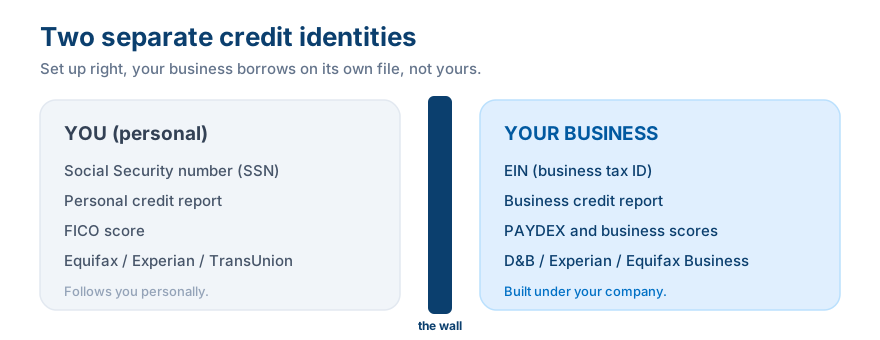
| Your SSN (personal) | Your EIN (business) | |
|---|---|---|
| What it identifies | You, the individual | Your business entity |
| Who issues it | Social Security Administration | The IRS |
| What file it builds | Personal credit at Equifax, Experian, TransUnion | Business credit at D&B, Experian Business, Equifax Business |
| Used to open | Personal cards and loans | Vendor accounts, store cards, business cards, business loans |
| Personal assets at risk? | Always | Only when you sign a personal guarantee |
| Cost to obtain | Assigned at birth | Free from the IRS in about 15 minutes |
The two files are separate, but they are not sealed off from each other. Lenders can and often do look at both.
So where does the “no SSN” idea break down? In two places. First, when you form your business and get your EIN, the IRS still ties the EIN to a responsible party, which is a real person with a Social Security number. Your business identity is separate, but it is not anonymous. Second, when you apply for bank credit or a major business card, the bank is legally required under know-your-customer rules to verify who owns and controls the business. That is why they ask for your SSN even on a business application, and why they frequently ask you to personally guarantee the debt. None of that means EIN credit is fake. It means the honest version is: you build an EIN file that stands increasingly on its own, and you graduate away from your personal credit over time rather than skipping it on day one.
The honest truth about “no SSN, no personal guarantee”
This is the section the hype pages skip, so read it carefully. It will save you from the two most expensive mistakes in this space: paying for shortcuts, and applying for things you cannot get yet.
What is actually true
- Your business credit file lives under your EIN, separate from your personal credit.
- Many net-30 vendor accounts and some store cards can be opened with no personal credit check, reporting to the business bureaus under your EIN.
- As your file grows deep and your business seasons, more accounts can be approved on the business alone, and some without a personal guarantee.
- You never have to use your personal credit as the foundation of your business credit. The foundation is your business identity and reporting accounts.
What is exaggerated or false
- That you can get large bank funding or major business cards with no SSN at all. Banks must verify the owner; they ask for your SSN even on business applications.
- That a brand-new business can get high-limit, no-personal-guarantee funding immediately. Time in business and depth are real requirements.
- That paying a fee “unlocks” your EIN credit faster. The bureaus do not work that way. The levers are free: report, pay early, stay consistent, and wait.
- That building business credit means you can walk away from a business debt with no consequences. If you signed a personal guarantee, you are on the hook.
A simple scam filter
If a service promises guaranteed, no-personal-guarantee funding for a brand-new business with no credit check, treat it as a red flag. The legitimate path is unglamorous and free to build. The only things you might reasonably pay for are optional conveniences like expedited processing, and you almost never need them.
You do not unlock business credit. You earn it, in order, and the order is the entire strategy.
Before you can build: the four-part foundation
Lenders score a handful of things before they ever score your accounts, and every one of them attaches to your EIN and business name. Get these right first, because a reporting account on a shaky identity still gets you declined. This is the part almost everyone rushes, and it is why so many owners are further from fundable than they think.
- A registered business entity. Form an LLC or corporation with your state. This is what makes your business a legal “person” that can hold credit under its EIN. See how to register an LLC with your state.
- Your EIN from the IRS. Free, fast, and the identifier everything attaches to. See how to get an EIN.
- A D-U-N-S number from Dun & Bradstreet. Free, and it opens your file at the largest business bureau. See how to sign up with Dun & Bradstreet.
- Consistent identity everywhere. Your exact legal name, address, and phone must match across your state filing, the IRS, your bank, your website, and every application, down to the punctuation.
That last point is quietly the most important, and the most ignored. Automated underwriting systems compare your records against each other. “ABC Holdings LLC” on your filing, “ABC Holdings, L.L.C.” on your bank, and “ABC Holdings” on your website can read as three different businesses, and inconsistency alone triggers manual review and declines. Pick one exact version of your business identity and make everything match it before you apply for a single account. It costs nothing and removes one of the most common silent reasons good businesses get declined.
The full identity stack
Round out the foundation with a business phone number listed in directories, a website on your own domain, an email on that domain, and a dedicated business bank account in your exact legal name. Each is a small trust signal; together they tell an underwriter your business is real. Our [foundation checklist](/blog/business-fundability-checklist) walks through all of it.
See exactly where your EIN credit stands right now
You do not have to guess which layer you are on. Take the free Business Fundability quiz: answer seven questions and get your score out of 100, your single biggest blocker, and the precise next move to become fundable.
Get my free Fundability ScoreThe three business bureaus your EIN file lives at
Your EIN credit is not one file, it is three, kept by three separate bureaus. They do not share data automatically, and lenders do not all pull the same one. Knowing this is what lets you build efficiently and, later, steer applications toward whichever bureau is strongest.
D&B
Dun & Bradstreet, home of the PAYDEX score
EX
Experian Business
EQ
Equifax Business
Dun & Bradstreet
The largest and most influential business bureau. Its best-known score is the PAYDEX, which runs from 1 to 100 and is driven almost entirely by whether you pay on time or early. A PAYDEX of 80 means you pay exactly on terms; scores above 80 are earned by paying before the due date. To have a D&B file at all, you need a D-U-N-S number, which is free. We break the score down fully in the complete PAYDEX score guide.
Experian Business and Equifax Business
Both build a file on your business automatically once accounts start reporting, and both blend your payment history with other risk signals into their own scores. You do not request a file the way you request a D-U-N-S number; it forms as data arrives. What matters is that your accounts actually report to them, that your identity data is correct, and that you check periodically for errors. Compare all three in our business credit bureaus comparison.
Report coverage matters
An account only helps the bureau it reports to. Some vendors report to all three, some to only one. When you choose accounts, choosing ones that report widely gives you more file for the same effort.
The build, in order: the three tiers
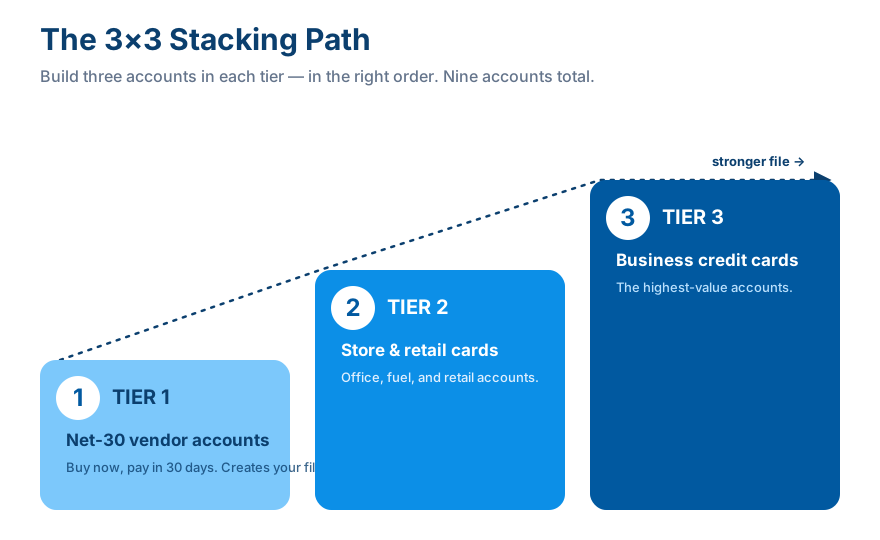
Here is the part most people get wrong. Business credit is built in a set order, and the order matters more than the number of accounts you open. Skip ahead and you burn inquiries on approvals you were never going to get, which makes your file look riskier for the accounts you actually could have gotten. Build in order and each layer earns you the next. Think of it as three tiers, three accounts each, nine accounts total.
Tier 1: net-30 vendor accounts
A net-30 vendor account lets you buy supplies now and pay the bill in 30 days. The right ones report your on-time payment to the business bureaus under your EIN, and that report is the first real entry in your file. This is how your EIN credit is created. Crucially, many net-30 starter vendors approve thin or brand-new files without a personal credit check, which is exactly the “EIN, not SSN” experience people are looking for, and it is completely legitimate. Open three that report, place a small real order on each so there is activity to report, and pay early. Our complete net-30 vendor guide covers how to choose them.
Tier 2: store and retail cards
Once your Tier 1 accounts are reporting, you qualify for business store and retail cards, the kind tied to office-supply, fuel, and home-improvement retailers. They are easier to get than a major business card and they thicken your file. Apply one at a time, only when your inquiries are cool, and keep balances low. Three reporting store cards set you up for Tier 3.
Tier 3: business credit cards
With Tiers 1 and 2 reporting, you are positioned for major business credit cards, the highest-value accounts and the ones that make a lender treat your business as a real borrower. This is also the tier where your SSN and possibly a personal guarantee come back into the picture, because major issuers verify the owner and often want that backstop, especially early. That is normal. Apply for the single best-fit card at a time, in an open window, and respect each issuer’s limits on how many new accounts you open at once. For the full walkthrough, see how to build business credit fast.
3
reporting net-30 vendors (Tier 1)
3
store cards (Tier 2)
3
business cards (Tier 3)
The rule for advancing
How do you know when to move up a tier? An account usually starts reporting within 30 to 60 days. Before you move up, confirm your current accounts are actually showing on the bureaus. If they are reporting and paid early, you are ready for the next layer.
Tier 1 deep dive: making sure a net-30 vendor actually reports
The whole value of a net-30 account is the reporting. An account that never reports to a bureau is, from a credit perspective, just an invoice you paid. Yet this is where beginners lose months: they open accounts that feel like they should help, use them diligently, and then discover nothing ever posted to their file. Vet before you rely.
- Confirm it reports before you count on it. The vendor should state which bureaus it reports to, or you should be able to verify by checking your file 30 to 60 days after your first paid order.
- Prefer vendors that report to more than one bureau. Broad reporting gives you more file per account.
- Place a small, real order on each account. An account with no usage has nothing to report. A modest purchase creates the tradeline.
- Pay early, not just on time. Dun & Bradstreet’s payment score rewards paying before the due date, so early payment starts your file strong instead of merely average.
- Space your applications. Do not open all three the same day; let each report before adding the next so your file builds steadily.
What a finished Tier 1 looks like
A reasonable target is three reporting net-30 tradelines, each used at least once and paid early, all confirmed on at least one bureau. That is a complete Tier 1 and the foundation everything else stacks on.
Tier 2 deep dive: turning vendor history into store cards
Store and retail cards are the bridge between starter vendors and real business credit cards. They are issued by or on behalf of specific retailers and are generally easier to qualify for than a major card, especially once you have reporting vendor history to point to. Their job in your build is to add revolving tradelines and thicken your file so the higher tier becomes reachable.
Approach them the same disciplined way you approached Tier 1. Apply one at a time rather than in a batch, because a cluster of applications in a few days reads as a business scrambling for credit. Apply only when your recent inquiries have cooled. Use each card lightly and pay it down before the statement closes so a low balance reports. Three reporting store cards, kept in good standing, is a complete Tier 2.
Tier 3 deep dive: the unwritten rules of major issuers
Tier 3 is where your business becomes a genuine borrower in a lender’s eyes, and also where impatience does the most damage. Major card issuers do not publish their exact thresholds, but the patterns are well known and worth respecting.
Velocity
Issuers watch how many new accounts you have opened in a short window. Opening several at once, across any lenders, signals a business suddenly hungry for credit. Space your applications and you avoid tripping velocity limits.
Recent inquiry sensitivity
Major issuers are the most sensitive to recent hard inquiries of any accounts you will apply for. A cluster of pulls in the weeks before you apply can sink an application that would otherwise sail through. Let inquiries cool first.
Personal credit and the guarantee
At this tier, expect the issuer to check the owner’s personal credit and to ask for a personal guarantee, especially in your first year or two. This is not a failure of your EIN credit; it is standard practice for high-value revolving accounts. Strong personal credit here unlocks bigger limits and better terms, so it is worth keeping healthy in parallel.
The ten things lenders actually score
Behind every approval or denial is a short list of signals. They are not a secret, and almost all of them are within your control. Here they are, grouped, with what to do about each.
Who you are
- ✓Business identity: a real, registered entity with an EIN and D-U-N-S
- ✓Profile consistency: exact name, address, and phone matching everywhere
- ✓Address and phone trust: a real street address and a listed business line
What is on your file
- ✓Bureau depth: how much seasoned history you have across the bureaus
- ✓Reporting tradelines: accounts actually reporting on-time payments
- ✓Bank behavior: a real business account with steady, healthy balances
How you behave and when you ask
- ✓Industry risk: how risky your field looks, and how you offset it
- ✓Inquiry pressure: how many recent hard pulls you carry
- ✓Utilization: how full your revolving accounts are
- ✓Application timing: whether you apply carefully or in a scramble
Read that list again and notice how little of it depends on your personal credit. Identity, consistency, address and phone trust, bureau depth, reporting tradelines, bank behavior, industry risk, inquiries, utilization, and timing are all things your business controls directly. Your personal credit is one input among many, and it matters most at the higher tiers and for bank funding, where it unlocks bigger limits rather than compensating for a weak file.
Utilization, inquiries, and timing on your business file
Three levers deserve their own note because they move fast and owners routinely sabotage them by accident.
Utilization
Utilization is how much of your available credit you are using: balances divided by limits. High balances relative to limits read as strain. Keep utilization low, generally under about 30 percent and lower is better, and pay balances down before your statement closes, because the balance that reports is the statement balance, not the amount you eventually pay. It is the single fastest lever on your file; you can move it in days.
Inquiries
Every application leaves an inquiry, and inquiries that cluster read as a business scrambling for credit. An over-inquired file gets declined regardless of how good the rest looks. Group the applications you actually need into planned windows, let the pressure cool between rounds, and, because the three bureaus each carry their own inquiry load, steer new applications toward whichever bureau is cleanest.
Timing
Timing is the most self-inflicted factor of all. You can do everything else right and still be declined purely because you applied too often or too soon. Apply in deliberate rounds with cool-off periods, and never force an application when your recent activity is still settling. Owners who follow their timing get approved; owners who apply on impulse keep getting denied.
Stop guessing and start building in the right order
Company Base OS turns all of this into your personalized 3x3 Stacking Path: exactly which accounts to open under your EIN, in what order, and precisely when to apply. Take the free Fundability quiz to get your score and your first move.
Get my free Fundability ScoreSole proprietor vs. LLC for EIN credit
A frequent question: do you need an LLC, or can a sole proprietor build business credit with an EIN? A sole proprietor can get an EIN and open some vendor accounts, but the separation between you and the business is weak, and many lenders will treat the debt as essentially personal. Forming an LLC or corporation does three useful things: it makes your business a distinct legal entity that can hold credit in its own name, it looks more established to underwriters, and it provides liability separation that protects your personal assets when you are not personally guaranteeing a debt. If your goal is a business credit file that stands on its own and eventually funds without a personal guarantee, a registered entity is strongly recommended, not optional.
Industry risk and your EIN file
Lenders attach a risk level to your industry before they ever look at you personally. Trucking, construction, restaurants and bars, staffing, and a handful of others carry a higher-risk label because, as categories, they see more volatility. A high-risk industry does not lock you out of EIN credit; it simply means a few of the other signals need to be a little stronger to balance the scale. You offset industry risk with an airtight identity, excellent and steady bank behavior, extra reporting depth, and by targeting lenders that already work with your field. Do not try to hide or misstate your industry; instead, present a business so consistent and well-banked that the risk label becomes a footnote.
How to check and monitor your EIN credit
You cannot build what you cannot see. As accounts start reporting, check that they actually appear on your file, that your identity data is correct, and that no errors or duplicates have crept in. Reporting errors and missing tradelines silently cap your progress, and catching them early protects the work you have put in. You do not need to buy every paid monitoring product; you need to know what each of the three bureaus shows about your business and to verify that the tradelines you expect are posting. Our guide on how to check your business credit walks through it. Checking your own file does not create a hard inquiry and does not hurt your score, so check freely, especially before any application.
When can you actually skip the personal guarantee?
This is the real question hiding inside “EIN, not SSN.” A personal guarantee is your promise that you will repay if the business cannot. No-personal-guarantee funding means the debt lives entirely on the business. It is a worthy goal, and it is genuinely achievable, but it is earned, not unlocked.
You move toward no-PG funding by building a deep, seasoned, reporting file, by demonstrating strong and steady bank behavior that proves the business can repay from its own cash flow, by favoring the accounts and lenders that offer no-PG terms once you qualify, and by accumulating time in business, which is its own powerful signal. Many net-30 vendors and some store cards already work on the business alone. As you climb, more of your funding can too. But expect major cards and bank loans, especially in the first year or two, to still want your guarantee. Our deep dive on business credit cards with no personal guarantee covers which accounts realistically qualify.
Personal credit is leverage, not a crutch
Even as you aim for no-PG, strong personal credit still helps. On the approvals that do want a guarantee, good personal credit unlocks bigger limits and better terms. It is leverage you spend deliberately while your EIN file does the heavy lifting everywhere else. Personal credit is not the enemy of business credit; it is a tool you use on purpose.
How long it takes to build business credit with an EIN
There is no honest overnight number, but there is a realistic one. Here is the shape of a normal build for a business starting from zero.
| Stage | Roughly when | What is happening |
|---|---|---|
| File created | Day 30 to 60 | Your first net-30 accounts report; your EIN file exists at the bureaus. |
| Tier 1 complete | Month 2 to 3 | Three reporting vendor accounts, all paid early. |
| Tier 2 building | Month 3 to 6 | Store cards approved and reporting; file thickening. |
| Tier 3 reachable | Month 6 to 12 | Major business cards within reach; genuinely fundable profile. |
| No-PG options grow | Year 1 to 2+ | With depth, seasoning, and strong banking, more funding can go no-PG. |
These are typical ranges, not guarantees. Consistent, in-order building is what compresses the timeline.
The fastest way to move through this is not a trick; it is order plus consistency. The owners who take two years are usually the ones who skipped tiers, applied on impulse, or let an account sit unused so it never reported. The owners who move in six to twelve months build the foundation once, open reporting accounts in sequence, and pay early every time.
What to do if you get denied
A denial on your EIN file is data, not a dead end. By law, a consumer credit denial comes with a written reason; for business credit, you may need to ask the lender directly, but you are entitled to know why. Once you have the reason, map it to its cause and fix that one thing before you re-apply. A thin file means open more reporting accounts and let them post. Too many inquiries means stop, let the pressure cool, and re-apply to a lender that pulls a cleaner bureau. High utilization means pay balances down first. An identity mismatch means make every record match. Re-applying without fixing the cause just burns another inquiry, so diagnose before you try again, and consider a reconsideration line where the issuer offers one.
A realistic walk-through: from zero to fundable
Consider a new single-member LLC, freshly formed, with an EIN and nothing else. Month one, the owner gets a D-U-N-S number and locks one exact version of the business name, address, and phone across the state filing, the IRS, the bank, and a simple one-page website on the business’s own domain, with a matching business email and a listed phone. Month one to two, they open three net-30 vendor accounts that report, place a small order on each, and pay every invoice a week early.
By the end of month two, those accounts begin posting; the EIN file now exists, with three tradelines and an early-payment history. Month three to five, the owner adds store cards one at a time, spacing applications and keeping balances under a third of each limit. By month six, the file has depth: reporting vendors and store cards, all paid early, on a consistent identity and a well-run business bank account. Now the owner reaches for a major business card, applies for the single best fit in an open window, and is approved, with a personal guarantee they expected. Nothing here was a secret. It was order, consistency, and patience, and it is entirely repeatable.
Common mistakes that stall an EIN credit file
- Getting an EIN and assuming you now “have business credit.” The EIN is the container; reporting accounts are the credit.
- Opening accounts that do not report. A net-30 account that never reports is just an invoice. Confirm reporting before you rely on it.
- Inconsistent identity. Different name, address, or phone formats across records quietly trigger declines.
- Applying out of order. Chasing Tier 3 cards before Tier 1 reports burns inquiries and stalls the file.
- Clustering applications. Too many inquiries in a short window reads as desperation and gets you auto-declined.
- Carrying high balances. High utilization on a reporting card drags your whole profile, even if you pay it off later.
- Paying for shortcuts. No fee makes the bureaus move faster. The levers are free: report, pay early, stay consistent, wait.
- Chasing “no SSN” to the point of avoiding banks entirely. You will need bank credit eventually, and that means verification. Build toward it, do not hide from it.
Your EIN credit action plan on one page
If you want the whole thing distilled, here it is. Do these in order and you will build a real business credit file under your EIN, the honest way.
- Register your business entity and get your EIN from the IRS.
- Get your free D-U-N-S number from Dun & Bradstreet.
- Lock one exact version of your business name, address, and phone, and make every record match it.
- Stand up the identity stack: listed phone, website on your domain, business email, and a dedicated business bank account.
- Open three reporting net-30 vendor accounts, use each, and pay early. Confirm they report.
- Add three store cards, one at a time, in open windows, keeping balances low.
- Reach for three business credit cards once Tiers 1 and 2 are reporting, best-fit and one at a time.
- Throughout, keep utilization low, inquiries cool, and timing deliberate.
- As depth and time in business grow, favor no-personal-guarantee accounts and step into real funding.
One next step, always
Wherever you are on this list, there is exactly one next step. You do not have to hold the whole plan in your head. Company Base OS builds it into your personalized 3x3 Stacking Path and tells you the single next move.
How each bureau scores your business
Your EIN file is scored differently at each of the three bureaus, and it helps to know what each one is really measuring. You do not need to obsess over the exact math, but understanding the levers tells you where to focus.
Dun & Bradstreet: the PAYDEX
D&B's flagship is the PAYDEX, a number from 1 to 100 built almost entirely from how promptly you pay. A PAYDEX of 80 means you pay exactly on terms; every point above 80 is earned by paying before the due date. This is why the single most powerful habit in business credit is paying early, not merely on time. D&B also maintains other indicators of risk and failure, but for most owners the PAYDEX is the number that opens doors. We cover it in full in the complete PAYDEX guide.
Experian Business
Experian blends your payment history with the age of your file, your credit utilization, the number and recency of inquiries, public records, and industry risk into its own business risk scores. Because it weighs more than payment timing, a strong Experian profile rewards depth and consistency over time, not just prompt payment. Keeping balances low and your identity data clean matters as much here as paying early.
Equifax Business
Equifax similarly combines your payment behavior with credit usage, the size and age of your accounts, and public records into its business scores. As with Experian, breadth and seasoning help. The practical takeaway across all three: pay early, keep utilization low, build depth, and keep your identity spotless, and you move every score in the right direction at once.
One set of habits, three scores
You do not chase three scores separately. The same handful of habits, early payment, low utilization, reporting depth, and clean identity, lift all three bureaus together. Focus on the habits, not the numbers.
Business credit vs. personal credit: how they interact
It is tempting to think of business and personal credit as completely walled off, but in practice they interact, and understanding how keeps you from unpleasant surprises. Building your EIN file does not touch your personal credit: vendor and store accounts that report to the business bureaus generally do not appear on your personal report. That is the good news, and it is the heart of the “EIN, not SSN” appeal.
The interaction happens at the edges. When you apply for a major business card or a bank loan, the lender frequently runs a hard inquiry on your personal credit and asks for a personal guarantee, which links that specific debt back to you. Some business cards also report to your personal credit, especially if the account goes delinquent. So the rule is simple: your EIN file is built independently, but your personal credit remains a factor at the higher tiers and for bank funding. Keep your personal credit healthy in parallel, not because your business file needs it to exist, but because strong personal credit unlocks bigger limits and better terms on the approvals that ask for it. We compare the two in detail in business credit vs. personal credit.
Building EIN credit for your specific situation
The framework is the same for every business, but the emphasis shifts depending on what you do. A few common cases:
A brand-new startup with no revenue
You can start today. The foundation and Tier 1 net-30 vendors do not require revenue, and many approve thin files without a personal credit check. Focus on building the identity stack and getting three reporting vendors posting; revenue-based funding comes later, once the file has depth.
An e-commerce or online business
Your website and domain email do real work here, because so much of your operation is online; make sure your business name, address, and phone are consistent across your site, your platform, and your listings. Net-30 supply and packaging vendors are natural first tradelines.
Trucking, construction, and other higher-risk fields
Your industry carries a risk label, so lean harder on the offsets: an airtight identity, excellent bank behavior, and extra reporting depth. Fuel and supply net-30 accounts fit your operation and build the file at the same time. Do not hide your industry; out-execute the label.
Real estate and holding companies
These often run through multiple entities, which makes identity consistency and clean separation between entities especially important. Each entity that will hold credit needs its own EIN, D-U-N-S, and file, built separately.
Established service businesses
If you already have revenue and time in business but never built the file, you are in the best position of all: build the foundation and stack tiers, and your existing bank history and operating record accelerate you toward no-personal-guarantee funding faster than a brand-new business.
The quiet power of your business bank account
Of all the signals lenders weigh, bank behavior is one of the most decisive and one of the most overlooked. Long before your credit file matters for a line of credit, a lender wants to see a dedicated business bank account, in your exact legal name, with steady deposits and a healthy average balance. That account is proof, in a way a credit report never can be, that your business actually operates and can repay from its own cash flow.
Open your account early, keep business and personal money strictly separate, run all your revenue and expenses through it, and avoid overdrafts. Banks quietly summarize how you handle money as an internal rating based largely on your average balance over recent months, and that rating gates the bigger funding, especially bank lines and anything backed by the SBA. Because months of clean banking history cannot be created overnight, the sooner your account is set up right, the stronger you look when you finally apply. See our step-by-step guide on opening a business bank account.
Maintaining and protecting your EIN credit for the long run
Building the file is the hard part, but a file you built can still erode if you ignore it. Maintenance is light but real. Keep paying every account early, because a single late payment can undo months of PAYDEX progress. Keep utilization low as your limits grow, so a bigger limit does not tempt a bigger balance. Watch your file across the three bureaus for errors, duplicates, and accounts that stop reporting, and fix them promptly, because a reporting error silently caps your score. And keep your identity consistent as your business changes; if you move, update every record, from your state filing to your bank to your directory listings, so nothing falls out of alignment.
Think of your EIN credit the way you think of your business's reputation, because that is exactly what it is. It compounds when you tend it and decays when you neglect it. A little attention each quarter protects everything you have built and keeps you ready to apply from strength whenever an opportunity appears.
Myths vs. reality, side by side
Because this topic attracts so much hype, it helps to see the most common claims next to what actually happens. Keep this table in mind whenever a pitch sounds too good.
| The claim you will hear | What is actually true |
|---|---|
| “Build business credit with no SSN.” | You build the file under your EIN, and many accounts need no personal credit check, but banks still verify the owner with an SSN. |
| “Get $50,000 with no personal guarantee, guaranteed.” | No-PG funding is earned over time; guaranteed, instant, no-PG money for a new business is a red flag. |
| “Pay us and unlock your business credit faster.” | No fee makes the bureaus move faster. The levers, reporting, early payment, consistency, are free. |
| “An EIN gives you business credit.” | An EIN is the container. Reporting accounts are the credit. An EIN alone is an empty file. |
| “Business credit means you can never be personally liable.” | Only true where you have not signed a personal guarantee. If you signed one, you are liable. |
When a claim lands in the left column, expect the right column to be the reality.
Your first 30 days: a quick-start
If you want a concrete place to begin, here is a realistic first month that sets up everything else. None of it requires revenue or good personal credit, and almost all of it is free.
- Week 1: Confirm your entity is registered and get your EIN from the IRS if you do not have one. Decide on one exact version of your business name, address, and phone.
- Week 1 to 2: Request your free D-U-N-S number from Dun & Bradstreet. Open or confirm a dedicated business bank account in your exact legal name.
- Week 2: Stand up a simple one-page website on your own domain, set up an email on that domain, and get a business phone number listed. Make every detail match your one exact identity.
- Week 3: Open your first reporting net-30 vendor account, place a small order, and set a reminder to pay it early.
- Week 4: Open a second and third reporting net-30 account, spaced a few days apart. Place small orders and prepare to pay each early.
At the end of thirty days you will not have a finished file, but you will have done the two things that matter most: built a clean, consistent identity, and set your first reporting tradelines in motion. Everything after this is repetition and patience.
Where your EIN credit leads
It is worth remembering why you are doing all of this, because the foundation and the nine accounts were never the goal. They are the key to the funding that is. Once your file is deep and reporting and your fundamentals are strong, real capital comes into reach.
- A business line of credit: drawable cash you pull, repay, and reuse, the flexible working capital most owners want first.
- Bank loans and lines: larger, lower-cost funding from a bank you have a real relationship with, rewarding your clean banking history.
- SBA loans: government-backed loans with strong terms for bigger needs, though they ask the most paperwork and usually a personal guarantee.
- Fintech and revenue-based funding: fast, flexible options that lean on your cash flow, convenient but worth checking carefully for true cost.
The cheapest funding usually asks the most of your profile; the fastest usually costs the most. That is exactly why you build the file first: so that when you need capital, you qualify for the good options instead of being forced into the expensive ones. Building business credit with your EIN is, in the end, about earning the right to choose.
Beyond loans: what business credit actually gets you
It is easy to think of business credit as only being about borrowing money, but a strong EIN file quietly improves your business in ways that have nothing to do with a loan application. Suppliers extend better terms to businesses with established trade histories, which improves your cash flow without costing anything. Landlords and equipment lessors check business credit before signing leases, and a solid file can mean a smaller deposit or better rates. Some business insurance carriers factor creditworthiness into premiums. Larger customers and partners run credit checks before doing business with you, and a healthy file signals stability. And, most importantly, every layer of business credit you build reduces how much you have to lean on your personal name and assets, which is the whole point.
So even in a season where you do not need to borrow, the file you build is working for you: better terms, smaller deposits, more trust from the businesses you deal with, and more separation between your company and your personal finances. Business credit is infrastructure, not just a funding tool.
Trade credit vs. cash credit
Two kinds of credit make up your business file, and knowing the difference clarifies the whole build. Trade credit is what vendors extend when they let you buy now and pay later, your net-30 accounts and store cards. It is the easiest kind to get, it is where you start, and it is what creates your file. Cash credit is money a lender gives you directly, business credit cards, lines of credit, and loans, that you can spend anywhere. It is harder to qualify for and comes later, once your trade credit history proves you pay reliably.
The sequence of the whole strategy follows this distinction: you use easy-to-get trade credit to build a track record, and that track record is what unlocks the harder-to-get cash credit. Owners who try to jump straight to cash credit with no trade history behind them are the ones who get declined and never understand why. Build trade credit first, and cash credit follows.
How to read your business credit reports
When you pull your file at each bureau, the layout can be intimidating, but the important fields are few. Here is what to look for so you can spot problems and confirm progress.
- Business identity block: your legal name, address, phone, and industry codes. Confirm these match your one exact identity everywhere. Errors here quietly drag on trust.
- Tradelines: each reporting account, with its credit limit or high balance, current balance, and payment history. Confirm the accounts you opened actually appear and show on-time or early payments.
- Scores and ratings: your PAYDEX at D&B, and the risk scores at Experian and Equifax. Track the direction over time, not just a single snapshot.
- Inquiries: recent applications that generated a hard pull. A cluster here is a warning to let pressure cool before applying again.
- Public records and derogatory items: liens, judgments, or collections. These carry real weight; address any that are inaccurate.
Checking your own report never creates a hard inquiry and never hurts your file, so review it regularly, especially before any application. The goal each time is simple: confirm your identity is correct, confirm your accounts are reporting and paid early, and catch any error before a lender does. Our guide on how to check your business credit walks through pulling each report.
Rebuilding business credit after a setback
Not every business credit journey is a straight line. A late payment during a rough month, a lien, or a period where the business stopped operating can leave marks on your file. The good news is that business credit, like the business itself, can be rebuilt, and the method is the same one that built it in the first place. Bring every account current first to stop the bleeding. Get utilization back down, since it is your fastest lever. Resume paying early on the accounts you keep, so a fresh run of positive history begins accumulating. Add new reporting tradelines to dilute the old negatives with new positive data. And let time do the rest, because negative marks lose weight as they age while your new positive history compounds.
Avoid the panic moves that make things worse: do not close your oldest accounts, do not open a flurry of new ones all at once, and do not pay for a service promising to erase accurate, timely information, because no one can legally do that. Steady, in-order rebuilding works. It just asks for the same patience the original build did.
The mindset that actually wins
If there is one idea to carry out of this guide, it is this: building business credit with your EIN is not a hack, a loophole, or a secret. It is a system, and the system rewards order, consistency, and patience over cleverness. The owners who win are not the ones who find a shortcut; they are the ones who build the foundation once, open reporting accounts in sequence, pay early every single time, and resist the urge to apply on impulse. Everything in this guide reduces to those few disciplines.
You now understand the business credit system better than most of the people selling courses about it. You know that the EIN is the container and reporting accounts are the credit. You know the order of the tiers and why it matters. You know the honest truth about no-SSN and no-personal-guarantee claims. And you know that the whole thing leads somewhere worth going: a business that stands on its own, funds on its own strength, and gives you the freedom to choose. Start with your first step today, and let the system do what it does.
Financing equipment and vehicles with your EIN
One of the most practical uses of business credit is financing the things your business runs on: equipment, machinery, and vehicles. Equipment and vehicle financing is often more accessible than a general line of credit, because the asset itself serves as collateral. That means a lender can extend credit against the equipment even when your file is still young, which makes it a useful early step toward larger funding for many businesses.
A strong EIN file still matters here, because it influences your rate, your terms, and how much of a personal guarantee the lender asks for. A business with reporting tradelines, clean banking, and time in business will finance a truck or a piece of machinery on better terms, and with less personal exposure, than one with an empty file. If equipment is central to your operation, building your business credit and pursuing asset-based financing can reinforce each other: the financing adds a reporting tradeline, and the growing file improves your next set of terms. As always, read the true cost of any offer carefully, especially from fast online lenders, and compare it against what your bank would offer.
Does business credit work differently by state?
A common question from owners who operate in one state and see advice written for another: does business credit vary by state? The bureaus themselves are national. Dun & Bradstreet, Experian Business, and Equifax Business build files the same way no matter where your business is located, and lenders across the country pull from the same three. What varies by state is the front end: how you register your entity, what your Secretary of State calls its filings, the fees, and how you look up a business record. Texas, for example, splits its lookups between the Secretary of State's paid SOSDirect portal and the Comptroller's free taxable entity search, while other states use a single free portal.
The practical takeaway is that your foundation steps, forming your entity and keeping your registration current, follow your state's rules, but everything after that, the D-U-N-S number, the tiers, the scoring, the funding, works the same everywhere. Use our state-specific how-to on registering an LLC for your foundation, then follow the same national playbook for the rest.
Glossary: the words you will keep seeing
- EIN: your business’s tax ID from the IRS; the identifier your business credit file is built under.
- D-U-N-S number: a free ID from Dun & Bradstreet that opens your D&B business file.
- Tradeline: any credit account listed on your file, such as a vendor account or card.
- Net-30: a vendor account where you buy now and pay within 30 days.
- PAYDEX: Dun & Bradstreet’s payment score, from 1 to 100, driven by paying on time or early.
- Utilization: your balances divided by your limits; keep it low.
- Inquiry: the record left when a lender checks your credit for an application.
- Personal guarantee (PG): your promise to repay a business debt personally if the business cannot.
- Fundable: the state where your profile is strong enough that a lender would say yes.
Frequently asked questions
Can I build business credit with only my EIN and no SSN?
You can build a business credit file that lives entirely under your EIN, and many vendor and store accounts can be opened without a personal credit check. But most banks and major card issuers still ask for a Social Security number to verify you as the owner and often require a personal guarantee, especially in the first year or two. Treat “no SSN ever” as a myth and “no personal guarantee eventually” as a realistic goal.
Is an EIN the same as business credit?
No. An EIN is your business’s tax ID number from the IRS. It is the identifier your business credit file is built under, but getting an EIN does not create any credit by itself. You build credit by opening accounts that report to the business bureaus under that EIN.
How long does it take to build business credit with an EIN?
You can create a file in 30 to 60 days by opening reporting net-30 vendor accounts, and reach a genuinely fundable profile in roughly 6 to 12 months of building in the right order. There is no overnight method.
Do I need an LLC to build business credit with an EIN?
You need a registered business entity and an EIN. An LLC or corporation is strongly recommended because it separates the business legally and looks more established to lenders. A sole proprietor can get an EIN, but the separation between you and the business is weaker.
Will building business credit hurt my personal credit?
Building the file itself does not. Most vendor and store accounts that report to business bureaus do not report to your personal credit. The exception is when an account or lender reports to a personal bureau or runs a hard personal inquiry, which some cards do. Read each account’s terms.
What are the three business credit bureaus?
Dun & Bradstreet, Experian Business, and Equifax Business. They are separate from the personal bureaus and each keeps its own file on your business. Your accounts must report to at least one of them to build your EIN credit.
Does my EIN credit have a single score like a personal FICO?
No single universal score. Each bureau has its own, the best known being Dun & Bradstreet’s PAYDEX, which runs 1 to 100 and rewards early payment. Lenders may look at one or several depending on which bureau they pull.
Can I use my EIN to get a business credit card with no personal guarantee right away?
Rarely for a brand-new business. Some vendors and store accounts work on the business alone, but major cards generally want your personal credit and a guarantee until your business has depth and time in business. No-PG major cards are something you grow into.
How much does it cost to build business credit with an EIN?
The core steps are free or low cost: the EIN is free, the D-U-N-S number is free, and building is a matter of opening reporting accounts and paying early. Be skeptical of anyone charging large fees to “unlock” credit; the bureaus do not work that way.
Can I build business credit for a business with no revenue yet?
Yes. The foundation and Tier 1 net-30 vendor accounts do not require revenue, and many approve thin, brand-new files. Revenue matters more later, for bank lines and larger funding, so start the file now and let it season while your revenue grows.
Do net-30 vendor accounts report to my personal credit?
Generally no. The right net-30 vendors report to the business bureaus under your EIN, not to your personal credit. Always confirm what a given account reports before you rely on it, since terms vary.
What is the fastest legitimate way to raise my business credit score?
Pay early rather than on time, keep utilization low, and make sure your accounts are actually reporting. These are the fastest-moving, free levers. Anyone promising an overnight jump for a fee is selling a shortcut that does not exist.
Does my personal credit score need to be good to start?
No. You can begin building your EIN file regardless of your personal score, because the foundation and early tiers do not hinge on it. Strong personal credit helps later, at the higher tiers and for bank funding, so improve it in parallel rather than waiting on it.
Can I finance a business vehicle or equipment with my EIN?
Often yes, and sometimes sooner than a general line of credit, because the asset acts as collateral. Your business credit still affects your rate, your terms, and how much of a personal guarantee is required, so building the file first gets you better financing.
Is business credit different in my state?
The three bureaus and the scoring are national and work the same everywhere. What differs by state is how you register your entity and look up business records. Follow your state's rules for the foundation, then use the same national playbook to build.
How many tradelines do I need to be fundable?
There is no magic number, but the common framework is nine reporting accounts across three tiers: three net-30 vendors, three store cards, and three business cards. Depth and on-time history matter more than the raw count.
What happens to my business credit if I close the business?
Your EIN file reflects the business, so once the business stops operating and its accounts close, the file stops growing. If you personally guaranteed any debts, you remain responsible for them. A future business would build a new file under its own EIN.
Build your EIN credit in the right order, tracked for you
Company Base OS shows you which accounts to open under your EIN, in what order, and exactly when to apply, so you never waste an inquiry. Start with the free Fundability quiz and get your score in about a minute.
Get my free Fundability ScoreKey takeaways
- 1.Business credit with an EIN is real: a separate file under your business name and tax ID, built by reporting accounts, not by the EIN alone.
- 2.“No SSN, no personal guarantee” is partly true and often oversold. You build an EIN file that stands increasingly on its own; you graduate away from personal credit rather than skipping it on day one.
- 3.Build in order: foundation and identity first, then Tier 1 vendors, Tier 2 store cards, Tier 3 business cards.
- 4.Keep utilization low, inquiries cool, and timing deliberate. These free levers decide most approvals.
- 5.No-personal-guarantee funding is earned through depth, seasoning, and strong banking, and it is worth the wait.
Company Base OS
Stop reading about it. Get your exact next move.
CompanyBase reads your business credit file and hands you the one account to open next, and the exact day to apply. Start with your free Fundability Score.
Get my free Fundability Score →60 seconds · no credit pull · founding access just $7 today
Company Base OS Research
Company Base OS is an educational platform that helps business owners build business credit and get funded, in the right order. Our team tracks lender and bureau criteria so you always know your exact next move.
← Previous
PAYDEX Score: The Complete Guide to Your D&B Business Credit Score
Next →
How to Check Your Business Credit (All 3 Bureaus)