Business Credit, Explained: The Complete Guide to Building It From Zero
Business credit is a separate file that lives under your EIN, not your Social Security number. Here is how to build it from zero, in the exact order lenders reward.
Company Base OS Research
Updated June 30, 2026 · 14 min read
In this article
Key takeaways
- 1.Business credit is a separate profile tied to your EIN and business name, scored by Dun & Bradstreet, Experian Business, and Equifax Business.
- 2.The order you build in matters more than the number of accounts you open. Wrong order burns inquiries and stalls approvals.
- 3.You become fundable by building a clean foundation, then layering reporting accounts from starter vendors up to bank credit.
- 4.Most owners are two to three layers below where they think they are, which is why they keep getting denied.
Most business owners find out business credit exists at the worst possible moment: right after a denial. They applied for a card or a line of credit on hope, got a no, and only then learned there is an entire credit system running under their business name that they never built. This guide fixes that. It walks through what business credit actually is, why the order you build in decides whether you get funded, and the exact sequence that takes you from nothing to fundable.
What business credit actually is
Business credit is a record of how your company borrows and pays, kept separately from your personal credit. It lives under your Employer Identification Number and your legal business name, not your Social Security number. When a vendor extends you net-30 terms or a bank issues your business a card, those accounts can report to the business bureaus and build a profile that lenders check before they approve you.
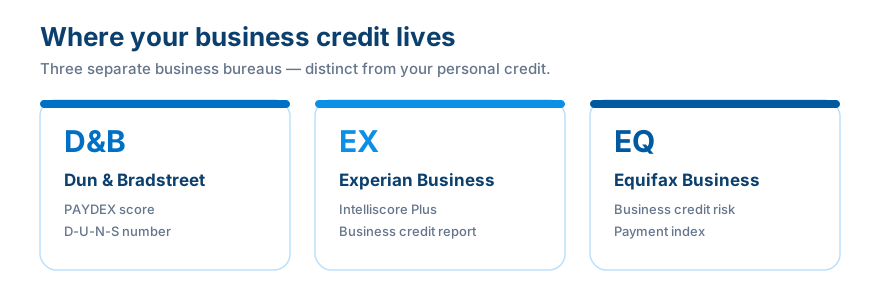
The three main business bureaus are Dun & Bradstreet, Experian Business, and Equifax Business. Each keeps its own file and its own score. The best known is the Dun & Bradstreet PAYDEX score, which runs from 1 to 100 and is driven almost entirely by whether you pay on time or early. A PAYDEX of 80 means you consistently pay on the due date. Scores above 80 require paying before the due date.
Business credit vs personal credit
Personal credit weighs utilization, history length, and inquiries heavily. Business credit, especially PAYDEX, is driven first by payment timing. Paying vendor invoices early is one of the fastest legitimate ways to move a business score.
Why the order matters more than the number of accounts
Here is the mistake that stalls almost everyone. They read that they need tradelines, so they apply to a pile of vendors and cards at once. Half get declined because the file is not ready, and the half that approve do not report where it counts. Every application is a hard inquiry, and every denial makes the next lender a little more cautious.
Credit builds in layers. Each layer qualifies you for the next. Open a major bank card before you have starter accounts reporting and the bank sees a thin, unproven file and says no. Build the same file in order and that same bank sees a track record and approves you. The accounts are the same. The order is the difference.
The build sequence, from zero to fundable
This is the layered path. Do not skip. Each step sets up the one above it.
- Foundation. Form a compliant entity, get your EIN, open a business bank account, and make sure your name, address, and phone are identical everywhere. Get listed with Dun & Bradstreet and obtain a D-U-N-S number. Lenders reject files with mismatched details before a human ever reads them.
- Starter reporting accounts. Open net-30 vendor accounts that report to the business bureaus. These are the easiest approvals and the first tradelines on your file. Pay early to push your PAYDEX toward and past 80.
- Vendor, fleet, and store credit. Once starter accounts report, layer in retail and fleet cards that report. This thickens the file and proves you can carry more.
- Regional and relationship-based credit. Build a relationship with a bank or credit union, which opens the door to accounts that a cold application never would.
- Major bank cards. With a proven, reporting file, the big issuers now approve you at real limits.
- Lines of credit and real capital. This is where the file finally pays off. Drawable cash and revolving lines, which have their own approval formula and stacking order.
The inquiry trap
Applying at the wrong layer, or too many times in a short window, creates inquiry pressure that gets approvable profiles denied on timing alone. Space applications and apply only when your file supports the product.
How to know which layer you are actually on
Most owners overestimate where they are. They think they are ready for a bank card when nothing is reporting yet, or they sit on starter accounts for a year without moving up because no one told them the file was ready. The fix is to diagnose your real layer before you apply for anything, then make one move at a time and log the result.
Business Fundability Score Calculator
How set up is your business foundation?
How many accounts are reporting to the business bureaus?
Where is your payment history / PAYDEX?
How many funding applications in the last 90 days?
Answer all four to see your estimated score.
Find out where you actually stand in 60 seconds
Take the free Business Fundability quiz. Answer seven questions and get your score out of 100, your single biggest blocker, and the exact first move to fix it.
Get my free Fundability ScoreCommon mistakes that quietly kill a business credit file
- Using your Social Security number instead of your EIN once you have an LLC and EIN.
- Inconsistent business name, address, or phone across the bank, the state, and the bureaus.
- Opening non-reporting vendor accounts and assuming they build credit. If it does not report, it does not count.
- Applying for major bank cards before starter tradelines report.
- Carrying high balances relative to limits, which signals risk even on a business file.
- Chasing shortcuts like shelf corporations or credit privacy numbers, which are how people get files shut down and, in some cases, break the law.
Frequently asked questions
How long does it take to build business credit?
A clean foundation can be set in days. Starter tradelines usually take 30 to 90 days to report. Reaching bank cards and real lines of credit typically takes several months of building in order, faster if you never waste inquiries.
Do I need an LLC to build business credit?
You need a registered entity and an EIN. An LLC or corporation separates your business from you and is what the bureaus and lenders expect. A sole proprietorship using your SSN does not build a separate business file.
Does business credit affect my personal credit?
Built correctly, business accounts report to the business bureaus and stay off your personal report. Some products require a personal guarantee, and a few can report personally, so the order and product choice matter.
What is a good PAYDEX score?
A PAYDEX of 80 means you pay on time and is the common threshold vendors and lenders look for. Above 80 means you pay early. Below 80 signals late payments.
Business credit is not complicated once you see it as a sequence instead of a pile of accounts. Build the foundation, layer reporting tradelines in order, and only apply for what your file can carry. Do that and you stop guessing, stop wasting inquiries, and actually become fundable.
Company Base OS
Stop reading about it. Get your exact next move.
CompanyBase reads your business credit file and hands you the one account to open next, and the exact day to apply. Start with your free Fundability Score.
Get my free Fundability Score →60 seconds · no credit pull · founding access just $7 today
Company Base OS Research
Company Base OS is an educational platform that helps business owners build business credit and get funded, in the right order. Our team tracks lender and bureau criteria so you always know your exact next move.