How to Get Business Funding With Bad Personal Credit
Turned down because of your personal credit? Bad personal credit narrows your options but does not lock you out. Here is the honest map of funding paths that lean on your business instead.
Company Base OS Research
Updated July 18, 2026 · 38 min read
In this article
- What lenders mean by “bad personal credit”
- The honest picture: what you can and cannot get
- Path 1: Build business credit under your EIN
- Path 2: Funding that leans on revenue, not your FICO
- Path 3: Secured and collateral-backed options
- Path 4: Community lenders and microloans
- Path 5: Repair your personal credit in parallel
- Why your bank account may matter more than your score
- Avoiding predatory lenders
- How to present your business to overcome weak credit
- A realistic two-track plan
- Common mistakes to avoid
- How Company Base OS helps when credit is the obstacle
- Funding by situation
- The graduation path: from secured to unsecured
Key takeaways
- 1.Bad personal credit narrows your options, but it does not lock you out. Several real funding paths lean on your business, your revenue, or collateral instead of your personal FICO.
- 2.Your business credit file lives under your EIN, separate from your personal credit, and you can build it regardless of your personal score.
- 3.The funding that is easiest to get with weak personal credit, such as merchant cash advances, is often the most expensive. Read the true cost before you sign.
- 4.The strongest move is a two-track plan: pursue business-based funding now while repairing your personal credit in parallel, since better personal credit unlocks cheaper options.
- 5.Revenue and bank behavior matter enormously. Many lenders care more about steady deposits than a perfect personal score.
If you have been turned down for business funding because of your personal credit, this guide is written for you, and it is going to be honest in both directions. It will not pretend that bad personal credit does not matter, because it does. But it will also not leave you believing you are stuck, because you are not. There is a real map of funding paths that lean on your business, your revenue, and your assets rather than your personal FICO score, and there is a clear plan for improving your position over time. By the end of this guide you will know exactly which doors are open to you right now, which ones to work toward, and which so-called opportunities to avoid.
Two ideas anchor everything that follows. First, your business credit is a separate file from your personal credit, built under your EIN, and you can grow it no matter what your personal score is. Second, the funding world is much wider than the bank loan that just declined you, and several corners of it weigh your revenue and collateral more heavily than your personal history. Put those two ideas together and a path appears. Let us walk it.
What lenders mean by “bad personal credit”
When a lender evaluates a small business, especially a young one, they often check the owner's personal credit as a proxy for how the business will handle debt. Personal credit scores generally run from 300 to 850, and lenders loosely group them into bands. Scores below roughly 580 are usually considered poor, the high 500s to low 600s are fair, and the mid 600s and up begin to open mainstream options. There is no single universal cutoff, because every lender sets its own, but the pattern is consistent: the lower your score, the fewer and more expensive your options, until you cross into the mid-600s where mainstream lending opens up.
It helps to know why lenders lean on personal credit at all. A new business has little or no track record of its own, so the owner's personal history is the best signal available for how the business is likely to behave. This is exactly why building your business's own credit file matters so much: as your business accumulates its own track record, lenders have something other than your personal score to rely on. Bad personal credit is a headwind, not a wall, and much of this guide is about the ways around it.
A score is a snapshot, not a sentence
A low score is a snapshot, not a sentence. It reflects your past, and it changes as your recent behavior changes. Many owners with weak personal credit fund their businesses successfully by using the paths below while steadily rebuilding their personal profile.
The honest picture: what you can and cannot get
Let us set expectations clearly, because false hope wastes your time and money. With genuinely bad personal credit, some funding is realistically available, some is available but expensive, and some is largely off the table until your credit improves. Knowing which is which keeps you from applying for things you cannot get, which only wastes inquiries, and from overpaying for the first thing that says yes.
| Funding type | Realistic with bad personal credit? | Notes |
|---|---|---|
| Net-30 vendor accounts | Yes, often no personal check | How you build your business file; start here. |
| Secured cards and secured lines | Yes | You put up a deposit; a practical building tool. |
| Invoice factoring | Often yes | Approval leans on your customers' credit, not yours. |
| Equipment and vehicle financing | Often yes | The asset is collateral, which offsets weak credit. |
| Revenue-based financing / MCA | Yes, but expensive | Approves on revenue; watch factor rates and true cost. |
| Business credit cards | Sometimes | Many check personal credit; some fair-credit options exist. |
| Bank term loans and lines | Difficult | Usually want stronger personal credit and history. |
| SBA loans | Difficult early | Most SBA lenders look for decent personal credit; microloans can be more flexible. |
Start where the answer is yes, build from there, and improve your personal credit to unlock the harder rows over time.
Path 1: Build business credit under your EIN
The foundational move, the one that helps regardless of your personal score, is to build your business's own credit file. This file lives under your EIN, separate from your personal credit, and many of the accounts that build it require no personal credit check at all. Every reporting account you add is a piece of a track record that lets lenders evaluate your business on its own merits rather than on your personal history.
Start with reporting net-30 vendor accounts, which frequently approve thin, new files without checking personal credit, then layer on store cards and, eventually, business cards. As your business file grows deep and seasoned, more funding becomes available on the strength of the business itself. This does not happen overnight, but it is the single most durable way to reduce your dependence on your personal credit. Our complete guide to building business credit with your EIN lays out the whole sequence, and our net-30 vendor guide covers the accounts that start it with no personal check.
Start the long game now
Building business credit is a marathon that pays off, not an overnight fix. Start it today even while you pursue faster funding, because in six to twelve months it changes what you qualify for.
Path 2: Funding that leans on revenue, not your FICO
A whole category of funding weighs your business's revenue and bank activity more heavily than your personal credit score. If your business has steady deposits, these options can be open to you even with a weak personal profile, though several come with a serious cost warning.
Invoice factoring and financing
If your business invoices other businesses and waits to get paid, factoring advances you most of an invoice's value now, and the factoring company collects from your customer later. Because approval leans on your customers' creditworthiness rather than yours, factoring can work well even with poor personal credit. The cost is a fee on each invoice, so it is best for businesses with real receivables and healthy margins.
Equipment and vehicle financing
When you finance a piece of equipment or a vehicle, the asset itself serves as collateral, which offsets weak personal credit because the lender can repossess the asset if you default. This makes asset-based financing one of the more accessible options for owners with credit challenges, and it doubles as a way to add a reporting tradeline to your business file. Your credit still affects the rate and terms, so shop carefully.
Revenue-based financing and merchant cash advances
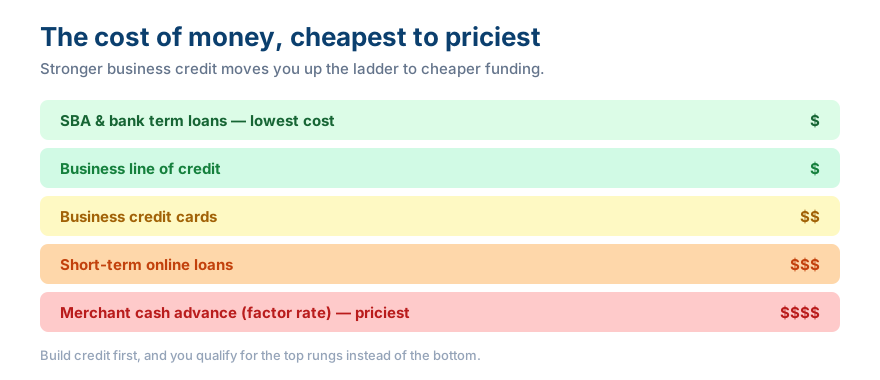
These provide a lump sum in exchange for a share of your future revenue or card sales, and they often approve on revenue alone, making them among the easiest to get with bad personal credit. That accessibility is also their danger: they are frequently the most expensive money available, quoted as a factor rate rather than an interest rate, with daily or weekly repayment that can strain cash flow. Treat them as a last resort and always calculate the true cost first. Our guide on how to read a funding offer shows you how to see through a factor rate.
Easy money is usually expensive money
The easiest funding to get with bad credit is often the most expensive. A merchant cash advance can carry an effective annual cost well into the triple digits. Before you accept one, convert the offer to a total payback number and compare it to every other option on this page.
Path 3: Secured and collateral-backed options
When a lender's risk is covered by collateral or a deposit, your personal credit matters far less, because the lender has a fallback if things go wrong. Two options in particular are practical building tools for owners with weak credit.
Secured business credit cards and lines
A secured card or line requires you to put up a cash deposit that backs your credit limit. Because the deposit covers the lender's risk, approval is far more attainable with poor credit, and responsible use, low balances paid early, builds positive history on the account. Think of a secured product as a stepping stone: you use it to demonstrate reliability, and over time you graduate to unsecured credit.
Collateral-backed loans and lines
Loans secured by business assets, inventory, equipment, or receivables shift the lender's focus from your personal score to the value of what backs the loan. These can be more accessible than unsecured bank credit, though you are putting an asset at risk, so borrow only what the business can comfortably repay.
Path 4: Community lenders and microloans
Not every lender is a big bank or an online cash-advance company. A whole ecosystem of mission-driven lenders exists specifically to fund businesses that traditional lenders overlook, and they often weigh your story, your plan, and your cash flow more heavily than a credit score.
- Community Development Financial Institutions (CDFIs): mission-driven lenders that serve underserved businesses and are frequently more flexible on credit than banks.
- Nonprofit microlenders: organizations that make small loans to early-stage and credit-challenged businesses, often with support and coaching attached.
- SBA microloans: made through nonprofit intermediary lenders, these smaller loans can be more flexible than standard SBA loans, though terms vary by intermediary.
- Local and community banks and credit unions: smaller institutions sometimes take a more relationship-based view than large national banks.
These lenders will not fund a business with no plan and no cash flow, but for an owner whose main obstacle is a low personal score rather than a failing business, they can be a genuine path. They tend to be more patient, more personal, and more willing to look at the whole picture. It is worth researching the CDFIs and microlenders that serve your area and industry.
Path 5: Repair your personal credit in parallel
Every path above is more powerful when your personal credit is improving at the same time, because better personal credit steadily unlocks cheaper and larger funding. You do not have to choose between building business credit and fixing personal credit; the strongest plan does both at once. And the good news is that personal credit responds to a few high-impact moves, most of which are free.
- Lower your utilization. Paying down credit card balances so you use a smaller share of your limits is the fastest-moving lever on a personal score. Aim to keep balances well under a third of each limit, and lower is better.
- Never miss a payment. Payment history is the single biggest factor. Set autopay for at least the minimum on everything so a slip never happens again.
- Stop opening new accounts for now. New applications add hard inquiries and lower your average account age while you are trying to recover.
- Let negative marks age. Late payments and other derogatory items lose weight over time. Protect everything else and let the calendar work.
- Dispute genuine errors. If your report contains inaccurate information, disputing it can help, but only real errors; no one can legally remove accurate, timely information.
Skip the credit-repair shortcuts
Be wary of any company promising to erase accurate negative information or boost your score overnight for a fee. The legitimate levers are free and take a little time. Most personal-credit recovery comes down to lower utilization and patience.
Because your business and personal credit are separate systems, this repair work runs quietly in the background while your business funding paths move forward. For how the two files interact, see business credit vs. personal credit.
Find your fastest path to funding
Company Base OS looks at your whole picture, business and personal, and shows you exactly which funding paths are open to you now and what to fix to unlock more. Take the free Fundability quiz and get your plan.
Get my free Fundability ScoreWhy your bank account may matter more than your score
Here is a fact that surprises many owners with weak personal credit: for a large share of business lenders, especially the revenue-based and online lenders, your business bank account tells a more important story than your personal credit report. These lenders want to see steady deposits, a healthy average balance, and consistent cash flow, because those things prove the business can repay. A strong bank account can offset a weak personal score in a way few owners realize.
This means one of the highest-leverage things you can do is run your business banking impeccably. Keep a dedicated business account in your exact legal name, run all your revenue and expenses through it, maintain a healthy average balance, and avoid overdrafts. Months of clean, steady banking history can open funding that your personal score alone would have blocked. Our guide on opening a business bank account covers doing it right, and the practice of keeping it strong is one of the best investments a credit-challenged owner can make.
Avoiding predatory lenders
Owners with bad personal credit are the exact target market for predatory lenders, because they are the most likely to feel they have no choice. Protect yourself. The most common trap is the offer quoted as a factor rate rather than an interest rate: a small-looking multiplier like 1.4 that, applied to the full amount and repaid over a few months in daily debits, can carry an effective annual cost well into the triple digits. Other warning signs include pressure to sign immediately, daily automatic withdrawals from your account, vague answers about the total payback amount, and steep fees buried in the paperwork.
Before you accept any fast-funding offer, do three things: ask for the total dollar amount you will repay, ask for the term and the payment frequency, and compare that total cost against at least one other option, ideally a cheaper one like a secured product, a CDFI, or your bank. If a lender will not give you the total payback clearly, that is your answer. Our full walkthrough on reading a funding offer shows you how to convert any factor-rate offer into a number you can actually compare.
The easiest yes is rarely the best yes. With bad credit, the discipline to compare offers is worth more than the speed of accepting one.
How to present your business to overcome weak credit
When your personal score is a liability, everything else about your application has to carry more weight, so presentation matters. Give a lender every reason to say yes by making the business look as real, stable, and low-risk as possible.
- Airtight identity: a registered entity, an EIN, consistent name, address, and phone everywhere, a listed business phone, a website on your own domain, and a business email. Consistency alone removes a common reason for declines.
- Strong bank behavior: steady deposits, a healthy average balance, and no overdrafts, since this often outweighs a weak personal score.
- A growing business credit file: even a few reporting tradelines show a track record separate from your personal history.
- Clear documentation: organized financials, bank statements, and a simple explanation of what the funding is for and how it will be repaid.
- The right lender: apply where your profile fits, revenue-based lenders, CDFIs, secured products, rather than where a strong personal score is required.
The theme is simple: compensate for the one weak signal by making every other signal strong. A business with a low personal score but a clean identity, steady banking, and a growing credit file is a very different applicant from one with a low score and nothing else, and lenders treat them differently.
A realistic two-track plan
Here is how to put it all together into a plan you can start this week. Run two tracks at once, one for funding now and one for a stronger position later.
Track one: funding you can pursue now
- Open reporting net-30 vendor accounts to begin your business file, most with no personal credit check.
- Run your business banking impeccably to build the cash-flow story lenders reward.
- For immediate capital needs, look first at secured products, invoice factoring if you invoice businesses, or equipment financing if you need an asset, and treat revenue-based advances as a carefully-checked last resort.
- Explore CDFIs and microlenders in your area for patient, relationship-based funding.
Track two: a stronger position in six to twelve months
- Keep building your business credit file through the tiers so more funding opens on the business alone.
- Repair your personal credit with the free levers: lower utilization, on-time payments, and patience.
- Keep your bank behavior strong and your identity consistent.
- Re-approach better funding, bank lines and eventually SBA options, as both your business file and personal score improve.
Do not wait to start
The owners who win with bad personal credit are the ones who do not wait. They take the funding that is available now, build the business's own credit in parallel, and repair their personal profile quietly in the background, so that in a year their options are completely different.
Common mistakes to avoid
- Assuming bad personal credit means no funding at all. Several paths lean on your business and revenue instead.
- Grabbing the first, easiest offer, usually the most expensive, without comparing the true cost.
- Applying repeatedly for bank loans you cannot yet qualify for, burning inquiries each time.
- Waiting to build business credit until your personal score is fixed. Start both now.
- Neglecting your business bank account, which is often the strongest card you can play.
- Paying for credit-repair shortcuts that promise to erase accurate information.
How Company Base OS helps when credit is the obstacle
When your personal credit is the thing standing between you and funding, the hardest part is often not the work itself but knowing which work to do, and in what order. This is exactly the gap Company Base OS is built to close. Instead of guessing which funding paths are open to you or applying blindly and burning inquiries, you get a clear read on where you actually stand and a prioritized plan for improving it.
Practically, that means a few things for a credit-challenged owner. It scores your overall fundability, so you can see how far your business-side strengths, revenue, banking, and file, offset your personal-credit weakness. It builds your business credit file in the right order through a personalized stacking path, so you reduce your reliance on your personal score month by month. It tells you when your profile is ready for a given kind of funding, so you apply when you are likely to be approved rather than when you are likely to be declined. And it keeps your identity consistent and your file monitored, the quiet signals that let a strong business overcome a weak personal score. None of that changes your FICO overnight, but it changes which doors are open to you, which is the point.
Make the rest of the picture undeniable
The goal is not to pretend your credit is better than it is. It is to make everything else about your business so strong, and so well-organized, that lenders can say yes anyway, and to know exactly which lenders will.
Funding by situation
The right first move depends on where you are starting. A few common situations:
A brand-new business with bad personal credit
Your business has no file and no revenue yet, so revenue-based options are limited and your personal credit is the main signal available. Focus on what you can control: register your entity, get your EIN, open reporting net-30 vendor accounts with no personal check, and run a clean business bank account. You are laying track now so that in a few months you have a business file and a cash-flow story to point to.
An established business with a recent credit hit
If your business has revenue and history but your personal credit took a hit, you are in a stronger position than you may feel. Lean on your revenue and bank behavior with revenue-based and asset-based lenders, keep building your business file, and repair your personal credit in parallel. Your existing operating record does real work here.
A business with steady revenue but a low owner score
This is the sweet spot for revenue-based and factoring options, because those lenders weigh deposits and receivables over personal credit. Present your bank statements and financials clearly, avoid the most expensive advances by comparing offers, and use the funding to grow while your personal credit recovers.
The graduation path: from secured to unsecured
One of the most encouraging patterns in this whole subject is that the tools you use with bad credit are designed to be temporary. A secured card becomes an unsecured one as you demonstrate reliability. A small microloan repaid on time builds the history that qualifies you for a larger, cheaper one. A business credit file that starts with net-30 vendors grows into one that supports real bank funding. The expensive or restrictive options are stepping stones, not destinations.
This is why the mindset matters as much as the mechanics. Every on-time payment, every month of clean banking, every reporting tradeline, and every point your personal credit recovers moves you toward better terms. The owner who understands this does not despair at a decline; they take the accessible option, use it well, and keep climbing. In a year, the business that could only get a secured card and a factoring line is often the business a bank is happy to lend to.
Frequently asked questions
Can I get business funding with bad personal credit?
Yes, though your options are narrower and some are more expensive. Paths that lean on your business revenue, invoices, or collateral, such as factoring, equipment financing, secured products, and revenue-based financing, can work even with poor personal credit, and you can build your business's own credit file regardless of your personal score.
What credit score do I need for business funding?
There is no universal cutoff, since every lender sets its own. Mainstream bank and SBA lending generally wants mid-600s or higher, while revenue-based lenders, factoring, secured products, and CDFIs can work with lower scores. Building business credit and strong bank behavior reduces how much your personal score matters.
Does business credit depend on my personal credit?
Your business credit file is separate, built under your EIN, and you can grow it regardless of your personal score. Personal credit still matters for many bank loans and major cards, especially early, but many vendor and secured accounts do not check it.
What is the easiest business funding to get with bad credit?
Revenue-based financing and merchant cash advances are often the easiest because they approve on revenue, but they are also usually the most expensive. Cheaper, more sustainable options include secured products, invoice factoring, equipment financing, and CDFIs. Compare the true cost before choosing.
Can I get an SBA loan with bad personal credit?
It is difficult early, since most SBA lenders look for reasonably strong personal credit. SBA microloans made through nonprofit intermediaries can be more flexible. Improving your personal credit and building your business file makes SBA options realistic over time.
How can I improve my chances of approval?
Make every signal other than your score strong: a consistent business identity, steady bank behavior with healthy balances, a growing business credit file, clear documentation, and applying to lenders whose criteria fit your profile.
Should I fix my personal credit or build business credit first?
Do both at once. Building business credit is a longer game that reduces your reliance on personal credit, while personal-credit repair, mainly lowering utilization and paying on time, unlocks cheaper funding as it improves.
Get funded without waiting on your credit score
Company Base OS maps the funding paths open to you right now, helps you build your business's own credit, and shows you what to fix to unlock more. Take the free Fundability quiz and get your personalized plan.
Get my free Fundability ScoreKey takeaways
- 1.Bad personal credit narrows your options but does not close them. Business-based, revenue-based, and collateral-backed funding can work.
- 2.Build your business credit file under your EIN in parallel; it reduces your reliance on your personal score over time.
- 3.The easiest funding, like merchant cash advances, is usually the most expensive. Always compare the true cost.
- 4.Strong bank behavior and a consistent identity can outweigh a weak personal score with many lenders.
- 5.Run a two-track plan: take available funding now while repairing personal credit and building business credit for a better position later.
Company Base OS
Stop reading about it. Get your exact next move.
CompanyBase reads your business credit file and hands you the one account to open next, and the exact day to apply. Start with your free Fundability Score.
Get my free Fundability Score →60 seconds · no credit pull · founding access just $7 today
Company Base OS Research
Company Base OS is an educational platform that helps business owners build business credit and get funded, in the right order. Our team tracks lender and bureau criteria so you always know your exact next move.
← Previous
How to Get an EIN From the IRS (Free, Step by Step)
Next →
PAYDEX Score: The Complete Guide to Your D&B Business Credit Score