
How to Read a Funding Offer (Factor Rate vs. APR)
Fast-funding offers hide their real cost behind a 'factor rate' instead of an APR. Here is how to convert any offer into a number you can actually compare.
Company Base OS Research
Updated July 19, 2026 · 9 min read
In this article
Key takeaways
- 1.A factor rate is not an interest rate. You multiply the amount borrowed by the factor to get the total you repay.
- 2.Short repayment terms make a modest-looking factor rate translate into a very high effective APR.
- 3.Before accepting anything, get three numbers in writing: the total dollar payback, the term, and the payment frequency.
- 4.The stronger your business credit, the more you qualify for cheaper, APR-priced options instead of factor-rate products.
When you need money fast, the offer that lands in your inbox is often a merchant cash advance or a short-term advance, and it will almost never quote you an APR. Instead it quotes a 'factor rate,' a small-looking number like 1.3 that hides how expensive the money actually is. Learning to read these offers is one of the most valuable financial skills a business owner can have, because the difference between a good offer and a predatory one can be tens of thousands of dollars. Here is how to see through the quote.
Why you need to read the offer carefully
Fast-funding products are designed to be easy to say yes to. They approve on revenue rather than credit, they fund in days, and they present the cost in a way that feels small. That accessibility is exactly why they are dangerous: many owners accept an offer without ever calculating the true cost, then find that daily or weekly repayments strain their cash flow far more than they expected. Reading the offer properly, before you sign, is what separates a tool you use deliberately from a trap you fall into. And the better your business credit profile, the more often you can skip these products entirely for cheaper, transparent financing.
What a factor rate actually is
A factor rate is a simple multiplier applied to the amount you borrow. Unlike interest, it does not compound and it is not expressed as a yearly percentage. You take the amount advanced and multiply it by the factor rate to get the total amount you will repay. The difference between what you receive and what you repay is your cost of capital.
The factor-rate math
Example: You are advanced $50,000 at a factor rate of 1.40. Your total payback is $50,000 x 1.40 = $70,000. That means the money costs you $20,000, regardless of how quickly you repay it.
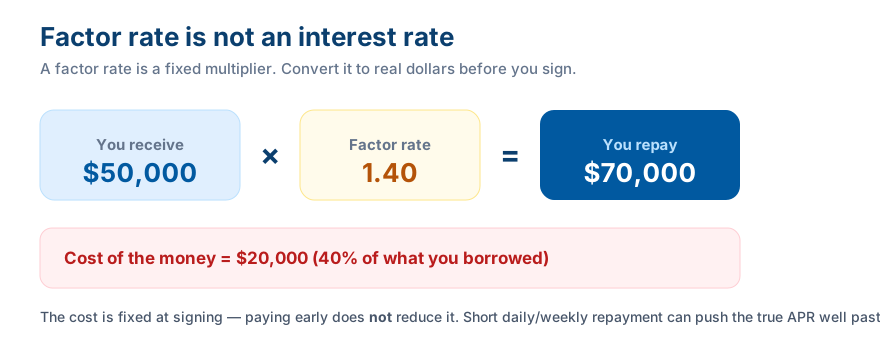
Notice what is missing from that math: time. With a true interest rate, paying the loan off early saves you money. With a factor rate, the cost is fixed the moment you sign, so repaying a $50,000 advance in six months costs the same $20,000 as repaying it in twelve. That is what makes a factor rate so different from an APR, and so easy to underestimate.
Why the term turns a 'small' factor into a huge APR
Because the cost is fixed but the repayment window is short, the effective annual rate on factor-priced money is usually far higher than it looks. That $20,000 cost on $50,000 is 40 percent of the amount borrowed. If you repay it over roughly six months through daily payments, the effective APR is not 40 percent, it is well over 70 percent once you account for the short term and the fact that your average outstanding balance is shrinking the whole time. The shorter the term and the more frequent the payments, the higher the true APR climbs. This is why comparing a factor rate to a bank loan's APR, without converting, badly misleads you.
The three numbers to demand, in writing
- The total dollar payback. Ask exactly how many dollars you will repay in total. This is the single most important number, and a straight answer tells you the real cost.
- The term. Over what period is the money repaid? A shorter term with the same factor rate means a higher effective APR.
- The payment frequency and amount. Daily, weekly, or monthly, and how much each payment is. Daily ACH withdrawals hit cash flow hardest, so know the exact rhythm before you commit.
No clear payback number? Walk.
If a funder will not put the total payback, term, and payment schedule in writing clearly, treat that as your answer and walk away. Transparency is the cheapest thing a legitimate lender can offer, and its absence is a red flag.
Red flags to watch for
- A refusal to state the total dollar payback, or answers that only ever come back as a factor rate.
- Daily ACH withdrawals from your business bank account, which can quietly drain the cash you need to operate.
- A confession of judgment or aggressive personal guarantee buried in the terms.
- Pressure to sign today, or an offer that 'expires' in hours.
- Encouragement to 'stack' a new advance on top of an existing one, which compounds the strain fast.
Common mistakes to avoid
- Comparing a factor rate to an APR without converting. They are not the same unit; convert to total dollars and effective APR first.
- Assuming early payoff saves money. With most factor-rate products, the cost is fixed at signing.
- Focusing on the payment size instead of the total cost. A comfortable daily payment can still hide an enormous total.
- Taking the first offer. Always compare against at least one cheaper, APR-priced alternative before deciding.
How this connects to building business credit
Here is the deeper point: you are usually offered factor-rate products precisely because you do not yet have the credit profile to qualify for cheaper ones. Merchant cash advances thrive on businesses that cannot get a bank line of credit or an APR-based term loan. As you build your business credit, open reporting tradelines, and strengthen your file, you graduate into financing that is priced in transparent APRs, often a fraction of the cost. Reading offers well protects you today; building credit is how you stop needing to read predatory offers at all. Company Base OS maps the exact path from where you are now to the fundability that unlocks cheaper money. The free Fundability quiz shows you where you stand.
Frequently asked questions
What is the difference between a factor rate and an APR?
A factor rate is a fixed multiplier on the amount borrowed (borrow $50,000 at 1.4 and you repay $70,000). An APR is an annualized interest rate that accounts for time. Factor-rate costs do not shrink if you pay early, and short terms make their effective APR very high.
How do I calculate the true cost of a factor-rate offer?
Multiply the amount advanced by the factor rate to get the total payback, then subtract the amount advanced to get your dollar cost. To compare with a loan, convert that cost and the repayment term into an effective APR.
Does paying off a merchant cash advance early save money?
Usually not. With most factor-rate products the total cost is fixed when you sign, so early repayment does not reduce it. Always confirm this in the specific offer.
Why are these offers so easy to get?
They approve on revenue rather than credit and fund quickly, which makes them accessible, but also expensive. Stronger business credit unlocks cheaper, APR-priced alternatives.
What should I do before accepting any funding offer?
Get the total dollar payback, the term, and the payment frequency in writing, then compare against at least one cheaper option like a bank line, a CDFI, or a secured product.
Qualify for cheaper money, not just faster money
Factor-rate offers target businesses without strong credit. Company Base OS shows you the exact steps to build the profile that unlocks transparent, APR-priced funding. Take the free Fundability quiz.
Get my free Fundability ScoreKey takeaways
- 1.A factor rate is a fixed multiplier, not an interest rate; convert it to total dollars and an effective APR.
- 2.Short terms and daily payments push the true APR far above what the factor rate suggests.
- 3.Demand the total payback, term, and payment frequency in writing before signing.
- 4.Building business credit is how you graduate out of factor-rate products entirely.
Company Base OS
Stop reading about it. Get your exact next move.
CompanyBase reads your business credit file and hands you the one account to open next, and the exact day to apply. Start with your free Fundability Score.
Get my free Fundability Score →60 seconds · no credit pull · founding access just $7 today
Company Base OS Research
Company Base OS is an educational platform that helps business owners build business credit and get funded, in the right order. Our team tracks lender and bureau criteria so you always know your exact next move.
← Previous
How to Set Up a Business Phone Number and 411 Listing
Next →
How to Sign Up With Dun & Bradstreet and Get Your Free D-U-N-S Number