Company Base OS · The Fundable Business
The Levels of Business Credit, Explained (And Where Most People Get Stuck)
Every business credit card roundup skips the part that actually matters: there is an order to this. Here is what each level of business credit actually requires, why jumping straight to a rewards card usually backfires, and how to find out exactly which level you are on right now.
CompanyBase Team
Updated November 17, 2026 · 10 min read
In this article
- Level 0: The Identity Layer (Before Any of This Starts)
- Level 1: Vendor Trade Credit (Net-30 and Net-60 Accounts)
- Level 2: Fintech Charge Cards (What We Call "Level 1" Cards Elsewhere on This Site)
- Level 3: Traditional Bank Business Rewards Cards
- Level 4: Real Financing — Lines of Credit, SBA Loans, and Larger Term Debt
- How CompanyBase OS Fits Into Every Level of This
Why this page exists
We just finished reviewing 30 traditional bank business rewards cards and 8 fintech charge cards on this site. The question we kept running into: which one should a business apply for first? The honest answer is neither — there is a level of business credit that has to exist before either kind of card makes sense, and most of the content online skips straight past it.
A business credit file is not one thing you either have or don't have. It builds in layers, and each layer unlocks access to the next — not because of some arbitrary rule, but because of how lenders and issuers actually underwrite. Skip a layer, and you don't get denied politely; you get approved for a number so small it isn't worth the hard inquiry, or declined outright with no explanation. Here is the order, in plain terms, and where the cards covered elsewhere on this site actually fit.
Level 0: The Identity Layer (Before Any of This Starts)
Before a business has any credit at all, it needs an identity lenders and bureaus can actually find: a registered entity, an EIN, a free D-U-N-S number from Dun & Bradstreet, and a dedicated business bank account — all using the exact same business name and address everywhere. This sounds like paperwork. It is actually the foundation every bureau file gets built on top of, and a mismatched address or name across these is one of the most common, invisible reasons a new tradeline fails to show up where it should.
Level 1: Vendor Trade Credit (Net-30 and Net-60 Accounts)
This is where an actual credit file starts to exist. A net-30 account lets you buy now and pay in 30 days; a handful of these, paid early rather than just on time, are what generate the first real entries in your D&B, Experian Business, or Equifax Business file. We go deep on the mechanics — including the part almost nobody explains correctly about paying early versus on time — in why net-30 and net-60 accounts matter for business credit. The short version: this level is not optional, and it is not something a rewards card replaces.
Level 2: Fintech Charge Cards (What We Call "Level 1" Cards Elsewhere on This Site)
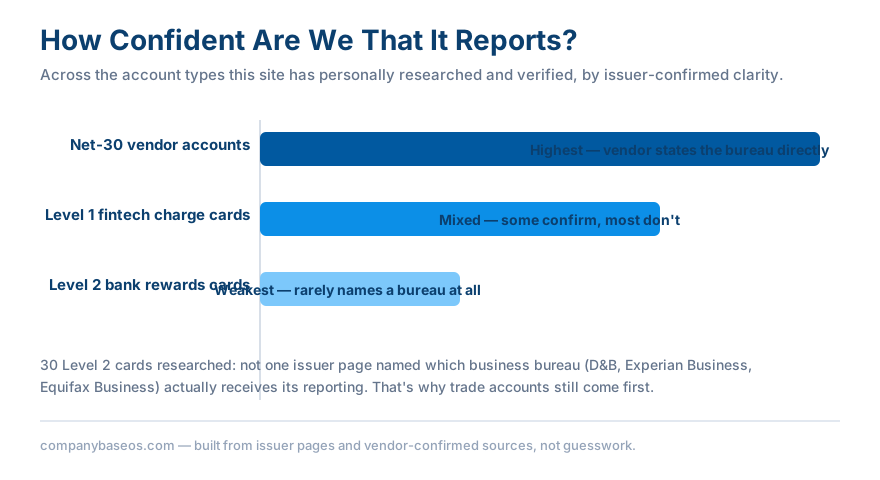
Once a handful of trade accounts are reporting, a business can usually qualify for a no-personal-guarantee corporate charge card — Brex, Ramp, Mercury, BILL, Navan, Rho, the Stripe Corporate Card, and Slash are the ones we have reviewed directly on this site. These underwrite on business cash flow and banking history rather than personal credit, which is exactly why they work before a business owner's personal credit is strong, or when keeping personal and business exposure separate matters. See the full no-personal-guarantee charge card comparison for the details on each. The catch, covered honestly in each of those reviews: confirmed bureau reporting is inconsistent across this whole category, with Brex and Ramp being two of the clearer exceptions.
Level 3: Traditional Bank Business Rewards Cards
This is the tier most people think of first — Chase Ink, Amex Business Gold and Platinum, Capital One Spark and Venture, Bank of America, U.S. Bank, Citi, Wells Fargo, and PNC's business cards, plus the airline and hotel co-brand cards. We just finished reviewing all 30 of them in our Level 2 business rewards card comparison hub. These cards require a personal guarantee, every single one of them, and lean on your personal credit for approval. In exchange, they offer real rewards depth — points, miles, travel perks, lounge access — that the earlier levels don't provide. This is the rewards layer, not the credit-building layer. Applying here first, before Levels 1 and 2 exist, is the single most common mistake we see: a thin file gets either declined or approved for a starting limit too small to be useful.
Free guide · instant access
The Business Foundation Checklist
Seven foundation mismatches that quietly cause automatic declines, and the fix for each.
Level 4: Real Financing — Lines of Credit, SBA Loans, and Larger Term Debt
With a documented trade history, a corporate card or two, and a personal credit profile strong enough to support a Level 3 card, a business is finally in position for the financing that actually moves a company forward: a revolving line of credit, equipment financing, or an SBA-backed loan. Underwriters at this level want to see the stack beneath it — reporting trade accounts, a card history, and consistent on-time (ideally early) payment behavior across all of it. This is the level every business owner actually wants to reach; the cards covered elsewhere on this site are the bridge, not the destination.
The mistake that costs the most time
Applying for a premium rewards card — or worse, several at once — before Levels 0 through 2 exist is the fastest way to collect declines and hard inquiries with nothing to show for them. Each hard inquiry is visible to the next lender. Build the stack in order.
How CompanyBase OS Fits Into Every Level of This
The hardest part of this entire ladder is not any single step — it is knowing which level you are actually on right now. Most business owners have never checked whether their D-U-N-S number is active, whether their last net-30 account actually reported, or whether their business bureau files even exist yet. Company Base OS exists specifically to answer that question in one place: it reads your actual fundability signals, tells you exactly which level your business is sitting at today, and lays out — in order — precisely which account to open next instead of leaving you to guess from a generic checklist. If you are reading the Level 1 or Level 2 card reviews on this site and trying to decide which one to apply for, the honest first step is this, not a card application.
- Confirm Level 0 is actually complete: matching name and address across your entity filing, EIN, D-U-N-S number, and business bank account.
- Open 2 to 4 net-30 vendor accounts and pay every invoice early, not just on time — this is Level 1, and it is not optional.
- Verify your bureau files directly 60 to 90 days after your first paid invoice, rather than assuming a vendor's reporting claim is accurate.
- Once trade accounts are reporting, apply for one no-personal-guarantee charge card (Level 2) rather than several at once.
- Only after Levels 0 through 2 are solid, consider a traditional bank rewards card (Level 3) — and pick it based on your real spend pattern, not the biggest bonus.
- Use Company Base OS to check exactly which level your business is actually sitting at before applying for anything, so you are not guessing.
Frequently asked questions
What is the very first level of business credit?
Before any credit exists, a business needs its identity layer in place: a registered entity, EIN, a free D-U-N-S number, and a dedicated business bank account, all under the exact same name and address. This is Level 0 — the foundation every bureau file is built on.
Can I skip straight to a rewards card if my personal credit is already excellent?
You can get approved, but it won't build a separate, verifiable business credit file. Strong personal credit gets you a Level 3 bank card; it does not create Levels 0 through 2, which is what lenders look for later when evaluating your business independently of you personally.
Why do net-30 accounts come before any credit card?
Because they are one of the only ways a brand-new business generates a reportable payment history without relying on personal credit at all. A thin or empty file is the most common reason a credit card application gets declined or severely limited, regardless of which level of card you apply for.
How do I know which level my business is actually on?
Most business owners don't, which is exactly the gap Company Base OS is built to close — it reads your actual fundability signals and tells you where you stand and what to open next, instead of leaving you to guess from a generic checklist.
Stop Guessing Which Level You Are On
Before you apply for another card — Level 1, Level 2, or anything else — find out exactly where your business stands with the bureaus right now, and precisely what to open next, in order. Free, in 60 seconds.
Get My Free Fundability ScoreCompany Base OS
Stop reading about it. Get your exact next move.
CompanyBase reads your business credit file and hands you the one account to open next, and the exact day to apply. Start with your free Fundability Score.
Get my free Fundability Score →60 seconds · no credit pull · founding access just $7 today
CompanyBase Team
Company Base OS is an educational platform that helps business owners build business credit and get funded, in the right order. Our team tracks lender and bureau criteria so you always know your exact next move.