Business Credit Scores Explained: PAYDEX, Intelliscore, and FICO SBSS
There is not one business credit score, there are several, each with its own range and meaning. Here is what each one is, and what counts as good.
Company Base OS Research
Updated July 21, 2026 · 9 min read
In this article
Key takeaways
- 1.There is no single business credit score; the major ones use different ranges.
- 2.PAYDEX and Experian and Equifax payment scores run 1 to 100; a strong score is high.
- 3.The FICO SBSS runs 0 to 300 and was long used for SBA prescreening.
- 4.As of March 1, 2026 the SBA no longer mandates the SBSS, though many lenders still use it.
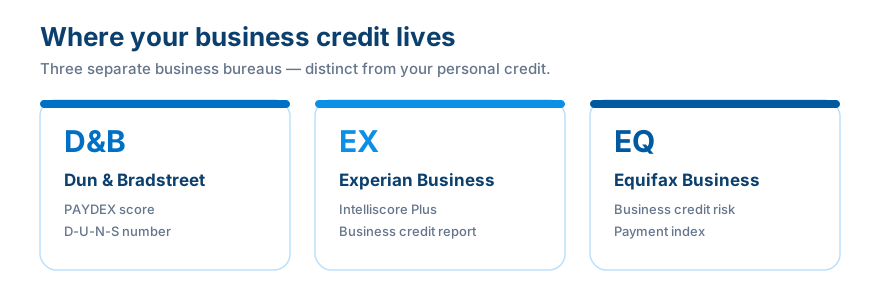
People say business credit score as if it is one number. It is not. Different bureaus and models each produce their own score, on their own scale, and lenders may check any of them. Knowing what each one is, and what counts as good, keeps you from chasing the wrong target. Here is the plain-English tour.
PAYDEX (Dun & Bradstreet)
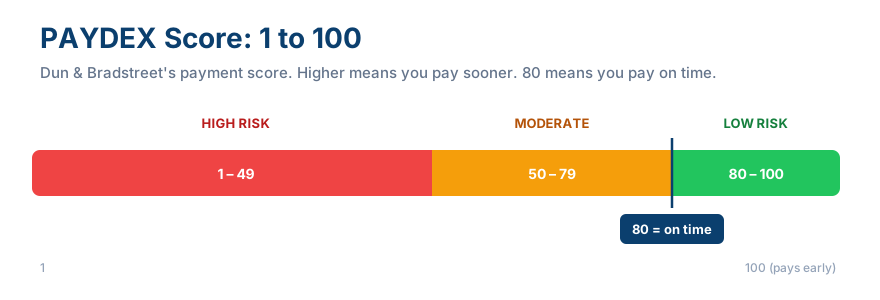
The PAYDEX is the best-known business score. It runs from 1 to 100 and is driven almost entirely by whether you pay on time or early. An 80 means you pay on the due date; scores above 80 mean you pay early. You need a D-U-N-S number and reporting tradelines before a PAYDEX exists.
Intelliscore Plus (Experian Business)
Experian builds a business file automatically once there is activity to report. Its Intelliscore Plus has historically run from 1 to 100, where higher means lower risk, blending payment history, credit usage, and other risk factors. Note that a newer version, Intelliscore Plus V3, uses a 300 to 850 range, so always check which scale you are looking at.
Equifax Business scores
Equifax reports several business scores rather than one headline number. Its Business Credit Risk Score predicts serious delinquency and runs on a wide range (roughly 101 to 992). Its Payment Index runs 1 to 100 and reflects on-time payment. It also publishes a Business Failure Score. The practical takeaway: with Equifax, know which specific score a lender is citing.
FICO SBSS
The FICO Small Business Scoring Service, or SBSS, runs from 0 to 300 and blends business and personal credit data. It was long used to prescreen SBA loan applications; the SBA had set a minimum of 165. Importantly, as of March 1, 2026 the SBA no longer mandates the SBSS for that prescreen, and lenders may use the model of their choice. Many lenders are expected to keep using the SBSS anyway, so it still matters.
The ranges at a glance
| Score | Range | Higher means |
|---|---|---|
| PAYDEX (D&B) | 1 to 100 | Pays on time or early |
| Intelliscore Plus | 1 to 100 (V3: 300 to 850) | Lower risk |
| Equifax Credit Risk | about 101 to 992 | Lower delinquency risk |
| Equifax Payment Index | 1 to 100 | More on-time payments |
| FICO SBSS | 0 to 300 | Lower risk to SBA lenders |
What counts as a good score?
On the 1 to 100 scales (PAYDEX, Payment Index, classic Intelliscore), aim for 80 or higher. The rule underneath every model is the same: pay early, keep utilization low, and build a consistent reporting history.
Business Fundability Score Calculator
How set up is your business foundation?
How many accounts are reporting to the business bureaus?
Where is your payment history / PAYDEX?
How many funding applications in the last 90 days?
Answer all four to see your estimated score.
Find out where you actually stand in 60 seconds
Take the free Business Fundability quiz. Answer seven questions and get your score out of 100, your single biggest blocker, and the exact first move to fix it.
Get my free Fundability ScoreFrequently asked questions
What is a good business credit score?
On the common 1 to 100 scales like PAYDEX, 80 or above is the target and signals low risk. Other models use different ranges, so compare against the specific scale a lender uses.
Which business credit score do lenders use?
It depends on the lender and product. Suppliers often look at PAYDEX; general lenders may use Experian or Equifax scores; SBA lenders have historically used the FICO SBSS. Build all of them by paying early and reporting consistently.
Is the FICO SBSS still required for SBA loans?
As of March 1, 2026 the SBA no longer mandates the SBSS for prescreening, and lenders may use the credit model of their choice. Many lenders are expected to continue using the SBSS regardless.
Company Base OS
Stop reading about it. Get your exact next move.
CompanyBase reads your business credit file and hands you the one account to open next, and the exact day to apply. Start with your free Fundability Score.
Get my free Fundability Score →60 seconds · no credit pull · founding access just $7 today
Company Base OS Research
Company Base OS is an educational platform that helps business owners build business credit and get funded, in the right order. Our team tracks lender and bureau criteria so you always know your exact next move.
← Previous
How to Check Your PAYDEX Score at Dun & Bradstreet
Next →
How Long Does It Take to Build Business Credit? A Realistic Timeline