How to Build Business Credit After Bankruptcy
A bankruptcy feels like it closes the door permanently. It does not. Here is exactly what changes on your file, what lenders actually look at first, and the real sequence to rebuild from here.
Company Base OS Research
Updated July 30, 2026 · 9 min read
In this article
Key takeaways
- 1.A bankruptcy is a public record that affects your file for a period of time, but it does not permanently disqualify you from business credit.
- 2.Personal bankruptcy and business entity bankruptcy affect your file differently; know which one applies to you.
- 3.Lenders weigh recent, consistent positive activity heavily, which is exactly what a rebuild sequence produces.
- 4.Starting a rebuild with a clean, consistent foundation matters more after a bankruptcy than it did the first time.
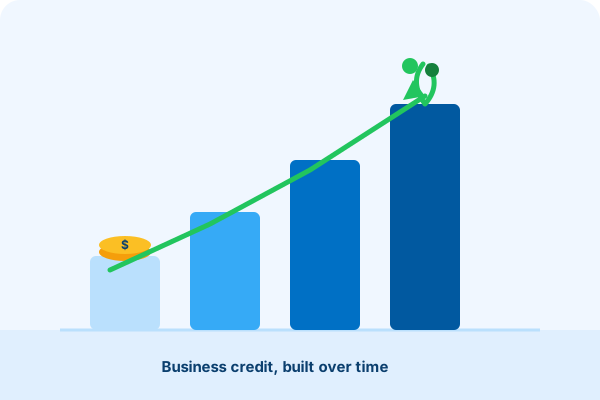
A bankruptcy feels like it should end the conversation about business credit entirely. It does not. It is a public record that lenders can see and that affects your file for a period of time, but business credit is rebuilt constantly by people who have been through exactly this. Here is exactly what a bankruptcy does to your file, what lenders actually weigh first, and the real order to rebuild in from here.
What a bankruptcy actually does to your file
The effect depends on which bankruptcy applies to you. A personal bankruptcy, especially one involving a personal guarantee you signed for a business account, shows up on your personal credit file and can indirectly affect future business applications that check personal credit. A business entity bankruptcy, like a Chapter 7 or Chapter 11 filing for the business itself, generally closes that entity's own credit file along with the business. If the original entity was dissolved, building forward often means forming a new entity and starting its file cleanly rather than trying to resurrect the old one.
How long a bankruptcy stays visible
Public bankruptcy records typically stay visible on credit files for several years, and the exact retention period varies by bureau and by the type of filing. Rather than fixating on a single number, treat it as a known, time-limited factor: it fades in weight as it ages, especially as fresh, consistent positive history builds up alongside it.
Time limited, not permanent
A bankruptcy's visibility window is finite and varies by bureau and filing type. The more relevant question is usually not "when does it disappear" but "how much positive history can I build in the meantime," since that is what lenders weigh heaviest going forward.
The real order to rebuild after bankruptcy
- Decide whether you are continuing an existing entity or forming a new one, based on what actually happened in the filing and what your attorney or accountant advises for your situation.
- Get the foundation clean first: consistent business name, address, phone, and EIN across your bank, state filing, and every bureau listing, exactly as if starting from zero.
- Open a small number of starter, reporting-focused tradelines and pay every one of them early, not just on time.
- Let those accounts post several clean payment cycles before applying for anything larger; a rushed application right after a filing usually gets declined and adds a fresh inquiry on top of an already sensitive file.
- Layer in slightly larger accounts only once the starter tradelines show a real, consistent early-payment pattern.
What lenders actually look at first
Lenders reviewing a file with a bankruptcy in its history are generally looking for one thing above all else: a real pattern of recent, reliable activity since the filing. A single clean tradeline paid on time barely moves that story. Several tradelines paid consistently and early, over a real stretch of months, is what actually starts to outweigh an older negative record in a lender's read of your file.
Rebuild checklist after a bankruptcy
- ✓Confirm whether you are rebuilding an existing entity's file or starting a new entity's file, and treat them differently
- ✓Fix any name, address, EIN, or phone inconsistency across your bank, state filing, and bureau listings
- ✓Open a small number of starter reporting tradelines and pay every one early
- ✓Wait for several clean reporting cycles before applying for anything beyond starter-tier accounts
- ✓Check your file directly against the [business fundability checklist](/blog/business-fundability-checklist) before applying for anything larger
Business Fundability Score Calculator
How set up is your business foundation?
How many accounts are reporting to the business bureaus?
Where is your payment history / PAYDEX?
How many funding applications in the last 90 days?
Answer all four to see your estimated score.
Find out where you actually stand in 60 seconds
Take the free Business Fundability quiz. Answer seven questions and get your score out of 100, your single biggest blocker, and the exact first move to fix it.
Get my free Fundability ScoreFrequently asked questions
Can I still build business credit after a bankruptcy?
Yes. A bankruptcy is a time-limited public record, not a permanent disqualification. Lenders weigh recent, consistent positive activity heavily, which is exactly what a deliberate rebuild sequence produces.
Should I use my old business entity or start a new one after bankruptcy?
It depends on what happened in the filing. If the entity was dissolved through the bankruptcy, forming a new entity and building its file cleanly is usually the practical path; if the entity is still active, you may be rebuilding that same file. Confirm with your attorney or accountant for your specific situation.
How soon after bankruptcy can I apply for business credit?
There is no universal waiting period, but applying immediately without any fresh positive history usually results in a decline and an added inquiry. Opening starter tradelines and letting a few clean cycles post first gives a much stronger application.
Does a personal bankruptcy always affect business credit?
It depends on whether you signed a personal guarantee tied to business accounts and whether the application in question checks personal credit at all. Business credit bureaus and personal credit bureaus are separate systems, so the effect is not automatic.
A bankruptcy changes the starting conditions, not the ending. Get the foundation clean, open a small number of accounts you can pay early, and let the fundability checklist and a steady, deliberate order do the rest.
Company Base OS
Stop reading about it. Get your exact next move.
CompanyBase reads your business credit file and hands you the one account to open next, and the exact day to apply. Start with your free Fundability Score.
Get my free Fundability Score →60 seconds · no credit pull · founding access just $7 today
Company Base OS Research
Company Base OS is an educational platform that helps business owners build business credit and get funded, in the right order. Our team tracks lender and bureau criteria so you always know your exact next move.
← Previous
What Is a UCC Filing?
Next →
Uline Net-30 Account: How It Works and Does It Report to Business Credit Bureaus